Chapter 3 · Foundations
Music Theory
“Music is the poetry of the air.”
—attributed to Jean Paul Richter
By the end of this chapter, you will be able to:
- Identify the three fundamental elements of music—rhythm, melody, and harmony—and explain the structural role each plays in any piece
- Describe how BPM, time signature, meter, straight versus swing feel, syncopation, and pocket placement combine to define a track's groove
- Derive the major scale and the natural minor scale from their specific half-step and whole-step interval sequences, starting from any of the twelve chromatic notes
- Explain why the pentatonic scale is the most widely used scale in popular music and apply it as a starting point for melody writing
- Distinguish the emotional effects produced by the I–IV–V, I–V–vi–IV, and ii–V–I chord progressions using scale degrees and Roman numeral analysis
- Apply the Circle of Fifths to map key relationships, identify relative major and minor keys, and transpose a song to a new key
- Apply melody-writing principles—stepwise motion versus leaps, motif and hook development, call and response, and vocal range matching—to construct a singable melodic line
- Describe how instrumentation choices, arrangement dynamics, and standard song sections (intro, verse, pre-chorus, chorus, bridge, and outro) shape the overall structure of a production
- Explain how seventh chords (maj7, dominant 7, and m7), sus and add9 colors, inversions and slash chords, and voice leading extend basic triads to produce the harmonic language of jazz, neo-soul, gospel, and R and B
When I was eighteen, I knew nothing about music theory. My roommate and I downloaded a demo copy of Fruity Loops on my ancient Dell computer and started plugging in dots and drawing piano rolls. We had no idea what a chord progression was—we just moved notes around until something sounded good. We would leave sessions open for days because the demo would not let us save. Once you closed the program, everything was gone. It did not matter. We would start over, and each time we learned something new about how notes worked together. That is how I learned music—not from a textbook, but from experimenting, failing, and listening. This chapter gives you the theory behind what we were discovering by accident. It will save you years of trial and error, but do not skip the experimenting part—that is where the real learning happens.
What Is Music?
suggest a correctionA line often attributed to Miles Davis puts it best: “It's not the notes you play, it's the notes you don't play.” Music is not just sound—it is the intentional arrangement of sound and silence into something that moves through time and makes you feel something. A single sustained tone is not music. A random cluster of sounds with no pattern is noise. Music lives in the deliberate shaping of when each sound starts, how long it holds, how loud it is, and how much silence sits around it.
Every piece of music ever made—a symphony, a hip hop beat, a lullaby hummed to a child—draws from three elements. One of them is always there; the other two are choices. Start with the one that is everywhere.
Rhythm is the pattern of sounds and silences in time. It is what makes music move and flow. If you listen for it, rhythm is everywhere: in a basketball being dribbled, hands clapping, raindrops falling on a window. Rhythm is the heartbeat. Every piece of music has it—without rhythm, the other two elements have nothing to ride on.
Melody is a sequence of notes unfolding over time—a musical sentence that your ear follows from beginning to end. Hum any song you know, and what comes out is the melody. It is the horizontal thread that pulls the listener through the music.
Harmony is what happens when notes stack vertically—two or more tones sounding at the same time to create chords. Harmony gives music its depth, its tension, and its resolution. A melody on its own can be beautiful, but add harmony underneath it and the same melody can sound hopeful, heartbreaking, triumphant, or haunting—depending entirely on the chords you choose.
A song can exist without harmony—a solo vocal melody has none. It can exist with melody barely present—a drum solo lives mostly on rhythm, though even drums carry tonal qualities (a kick is in a key whether or not you tuned it that way, and so is everything else with a drumhead). What every piece of music has in common is rhythm. The rest of this chapter is about understanding all three elements and how to use them. We will start with tempo and rhythm—the heartbeat of every track—then move through notes, scales, chords, melody, instrumentation, dynamics, and song structure.
Tempo and Time Signatures
suggest a correction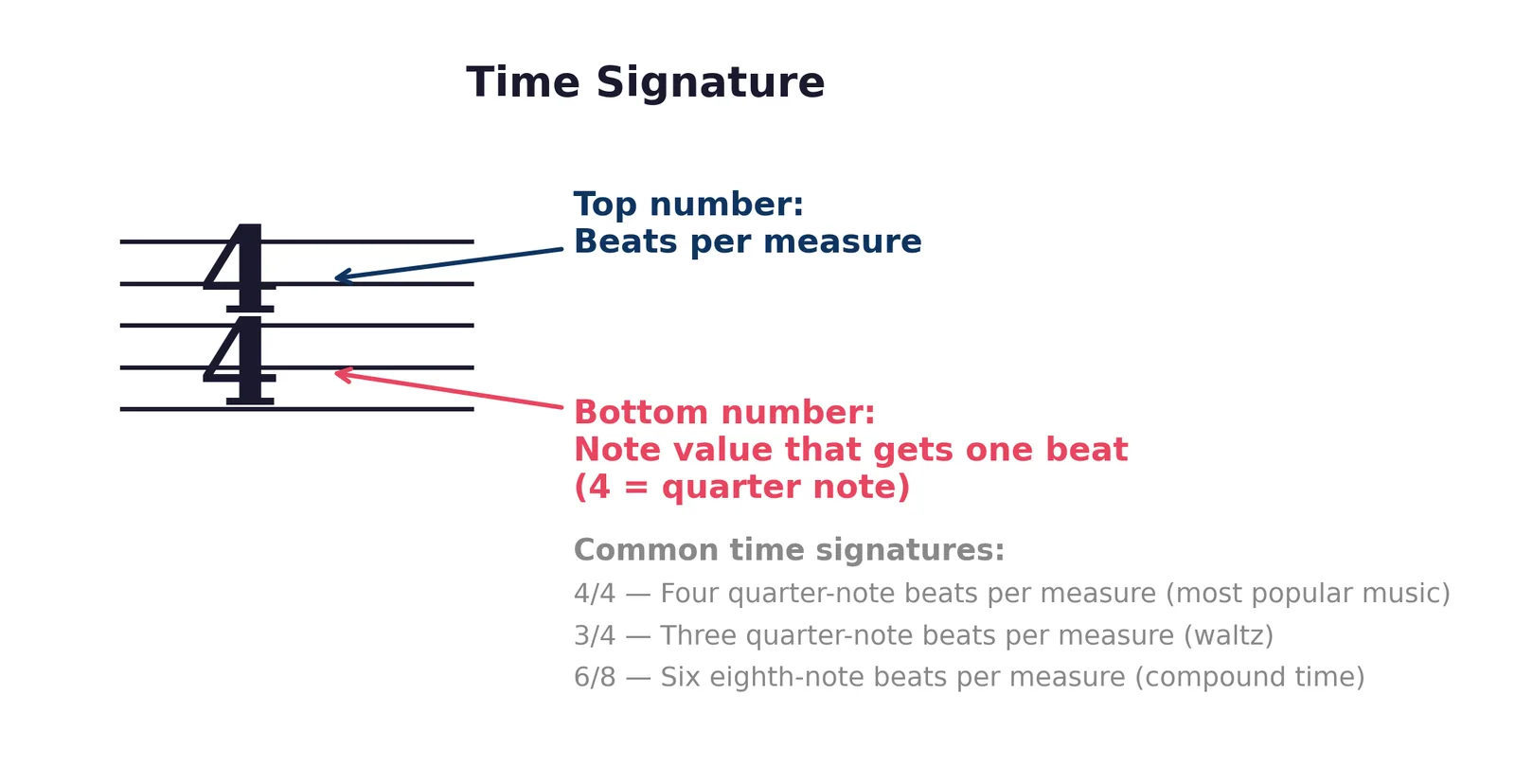
Before you write a single note, you have to answer one question: how fast is this song? Tempo is the speed of the music, measured in BPM—beats per minute. A ballad sits at 65. A house track locks in at 128. A drum and bass tune races at 174. That single number defines the feel of everything that follows—the kick weight, the hi-hat density, the vocal phrasing. Get the tempo wrong and nothing else will save the track.
Early in my career I had a drum and bass producer drop a 174 BPM session in front of me with a vocalist who could not keep up. We tried it for three takes. Stiff every time. I asked him: what if we treat this as half-time at 87? Same drums, same bass, but the vocalist now phrases over a slower pulse. He hated the idea. We tried it anyway. The song unlocked. Same BPM. Different relationship to it.
Beats are the basic pulse—the thing your foot taps to, the thing your head nods to. A group of beats is called a bar (or measure). The time signature tells you how many beats are in each bar and what kind of note gets one beat. The vast majority of popular music lives in 4/4 time—four beats per bar, with a quarter note getting one beat. When you hear a song and count “1, 2, 3, 4, 1, 2, 3, 4,” you are counting bars in 4/4. A typical pop song has 80–100 bars, meaning 320–400 beats from start to finish.
Think of a simple drum pattern: boom, tap, boom, tap—each sound equidistant, each one a quarter note. That is one bar in 4/4. Each boom is a beat and each tap is a beat. Four beats, one bar. Four more beats, two bars. And that grid is what your entire song sits on.
3/4 time is another common meter—three beats per bar instead of four. This is the waltz: ONE-two-three, ONE-two-three. You can also bring 3/4 into a 4/4 world by using triplets—three evenly spaced notes in the time normally occupied by two. Triplets give you that rolling, swinging feel you hear in blues shuffles and R&B grooves. Three triplet eighth notes fit into the space of one quarter note.
Less common but worth knowing: 5/4 time (five beats per bar—think Paul Desmond's “Take Five,” recorded by the Dave Brubeck Quartet, or the Mission: Impossible theme), 7/8 time (seven eighth notes per bar—common in progressive rock and Middle Eastern music), and shifting meters that change measure to measure (Radiohead, Tool, and modern math rock all live here). Pop and hip hop stay almost exclusively in 4/4 because that is what the human body naturally locks onto—but knowing other meters exist gives you tools when 4/4 starts to feel predictable.
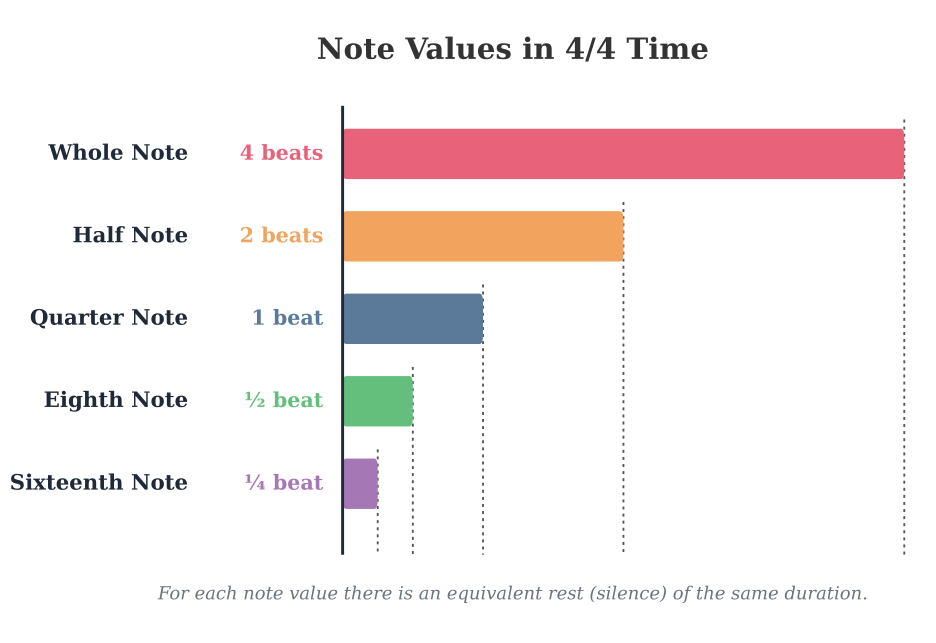
Dotted notes extend a note's duration by half its original value. A half note normally gets two beats; dot it and it gets three. A dotted quarter note gets one and a half beats instead of one. Small detail, big result—dotted notes create rhythmic variety and keep patterns from feeling rigid.
The metronome—whether a physical device or the click track in your DAW—produces a steady pulse at your chosen BPM. Every professional session uses one. It is the invisible backbone that keeps every musician, every overdub, and every edit locked to the same tempo. If you have ever tried to edit a performance that was recorded without a click, you know exactly why it matters: nothing lines up, and simple edits become painful. Modern DAWs go beyond a plain tick—Pro Tools and Logic let you customize the click sound (wood block, side stick, cowbell), the accent on beat one, and the count-in length. For songs that need to breathe, you can program a tempo map that changes BPM by bar or beat, so a verse can sit at 92 and the chorus can lift to 96 without the click ever feeling off.
Notation also captures silence, not just sound. A rest is a silence that lasts for the same duration as its corresponding note: a quarter rest is one beat of silence, a half rest is two, a whole rest fills an entire bar. Here is a summary of standard note values in 4/4 time:
Choosing a Tempo
suggest a correctionChoosing the right tempo is one of the first and most important decisions a producer makes. Here is a guide to BPM ranges and the genres that live within them:
| BPM | Feel | Common Genres |
|---|---|---|
| 60–70 | Very slow | Soul & R&B ballads, gospel ballads |
| 70–85 | Slow | Lo-fi hip hop, trip-hop, downtempo, classic soul |
| 85–95 | Mid / head-nod | Boom-bap hip hop, neo-soul |
| 90–100 | Laid-back groove | Reggaeton, dancehall, reggae (one-drop), Afro-swing |
| 100–115 | Mid-up | Pop, Afrobeats (100–112), funk |
| 115–125 | Up | Disco, nu-disco, dance-pop |
| 120–130 | Four-on-the-floor | House (124–128), tech/deep house |
| 130–140 | Driving | Trance (132–138), big-room EDM, Jersey club, UK garage (130–135), dubstep ( 140, half-time) |
| 138–150 | Hard / half-time | Trap & drill (~140, felt ~70 half-time), UK drill (140–145), techno (130–150) |
| 150–175 | Very fast | Hardstyle (~150), footwork (~160), drum and bass (170–176), jungle |
BPMs that are double or half of one another are essentially the same pulse, only twice as fast or twice as slow. So 200 BPM is the same pulse as 100 BPM. This is why trap at 140 BPM can feel like a slow groove—the kick and snare hit in a half-time pattern at an effective 70 BPM.
I have watched two BPM be the difference between a track feeling exhausted and feeling alive. Bumping a chorus from 96 to 98 sometimes opens up a song the way nothing else can. The opposite is just as true—pulling 4 BPM out of a track that is running hot and frantic, and watching it settle into the pocket. Tempo is not a sticker you slap on at the start of a session. It is a dial you keep nudging until everything else clicks.
Rhythm Patterns and Groove
suggest a correctionWhile tempo tells you how fast the music moves, rhythm patterns determine how it feels. Two songs at 120 BPM can feel completely different depending on how the drums and other rhythmic elements sit. Understanding common rhythm patterns is what separates a producer who can make a track groove from one whose programming sounds like a quantize button mashed without taste.
Straight, Swing, and Syncopation
In a straight feel, all subdivisions are equally spaced—eighth notes are perfectly even. In a swing feel, the first eighth note of each pair is held slightly longer than the second, creating a “bounce.” Swing is essential to jazz, blues, and many hip hop styles. Most DAWs have a swing or groove percentage control that lets you dial in the amount: 50% is straight, 60–66% is hard swing, and the magic for most boom-bap and neo-soul lives between those two.
Syncopation places rhythmic emphasis where the listener does not expect it. Instead of accenting beats 1 and 3 (the “strong” beats in 4/4), syncopated rhythms emphasize the “and” between beats, or beats 2 and 4. Syncopation is what makes music feel funky, danceable, and alive instead of rigid and mechanical.
Drum Patterns by Genre
Different genres are built on different drum DNA. The pattern is not just decoration—it is the genetic code that tells your ear what kind of song this is going to be. A few you should be able to program from memory.
The four-on-the-floor pattern puts a kick on every beat: 1, 2, 3, 4. It is the backbone of house, disco, techno, and a huge swath of pop. Simple but powerful—the dance floor does not negotiate with this kick.
The boom-bap pattern sits the kick on beats 1 and 3 with the snare answering on 2 and 4, hi-hats syncopated and slightly swung. This is the classic 1990s East Coast hip hop feel. Producers like DJ Premier, Pete Rock, and J Dilla built their legacies on variations of it. The trick is the swing and the slight grid drift—boom-bap played perfectly on the grid stops being boom-bap.
Trap replaces the swung hi-hats with rapid rolls, often 32nd notes, with sudden pauses, pitch-shifted variations, and triplet bursts thrown in. Combined with heavy 808 bass and sparse, hard-hitting snares, this is the rhythmic skeleton of modern trap, drill, and most contemporary hip hop.
The backbeat—snare on beats 2 and 4—is the foundation of nearly all rock, pop, funk, and R&B. It is so fundamental it is easy to overlook. Strip it out and the song stops feeling like a song; it feels like a sketch.
Reggae and dancehall put the emphasis on beat 3, with guitars or keys playing the “skank” on the offbeats (the “and” of each beat). The kick pattern is often syncopated, which is what gives Caribbean music its laid-back, head-nodding feel.
Latin music is organized around the clave—a two-bar rhythmic key pattern (most commonly son clave, counted 3–2 or 2–3 depending on which bar leads) that every other part in the arrangement aligns with. The clave is not always played out loud, but it is always implied: percussion, bass (the syncopated tumbao), and piano all lock to it. The piano's signature part is the montuno—a syncopated, repeating two-handed vamp that outlines the harmony while riding the clave. Bossa nova carries its own quieter version of the same idea: a clave-like pattern on the rim, a steady bass anchoring beats 1 and 3, and the harmony floating in syncopation above it. If you produce or mix Latin material, learn to hear which side of the clave a section starts on—flipping it by accident is the genre's most audible mistake, the equivalent of dropping a beat in 4/4.
Polyrhythm and Cross-Rhythm
Polyrhythm is two or more rhythms played at the same time that don't share the same subdivision—most commonly three against two. You hear it in West African drumming, jazz, prog rock, and increasingly in modern hip hop where producers layer triplet hi-hat rolls over a 4/4 grid. The triplet pattern doesn't line up with the eighth-note grid, which is exactly what creates the tension and momentum. Done well, polyrhythm is what keeps a four-bar loop interesting. Done poorly, it sounds like a mistake.
The Pocket
When all the rhythmic elements of a performance lock together perfectly, musicians say the groove is “in the pocket.” This does not mean everything is perfectly on the grid—in fact, slight human timing variations are often what make a groove feel good. Try nudging hi-hats five milliseconds ahead of the beat for urgency, or five behind for a laid-back feel. The first time I did that on a hip hop session and the producer said “that's it—that's the feel,” I understood that the grid is a starting point, not a destination. Programming drums that feel in the pocket rather than stiff and robotic is one of the most valuable production skills you can develop.
Notes, Keys, and Intervals
suggest a correction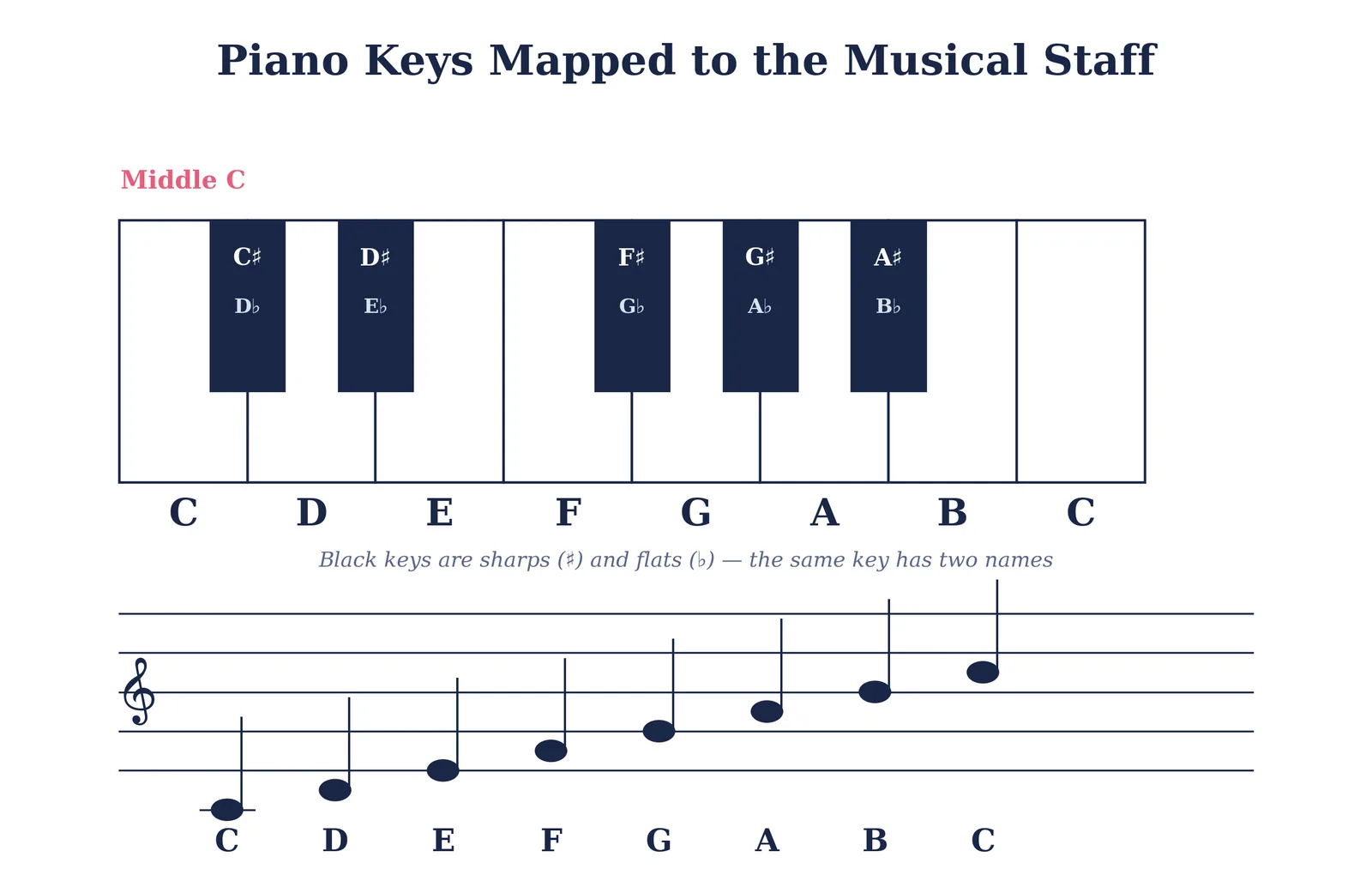
If tempo is the heartbeat, notes and keys are the palette. The keys a producer chooses are analogous to the colors a painter chooses—different keys convey different moods, and that choice colors everything downstream: the scale, the chords, the melody, even which instruments sound best.
There are only 12 notes in the modern equal temperament tuning system (Howard & Angus, 2017). That is it—just 12. Every piece of music you have ever heard, in any genre, in any language, is built from some combination of these same 12 notes. What makes each piece sound different is which notes are chosen, how they are combined, and the rhythm and phrasing used to deliver them.
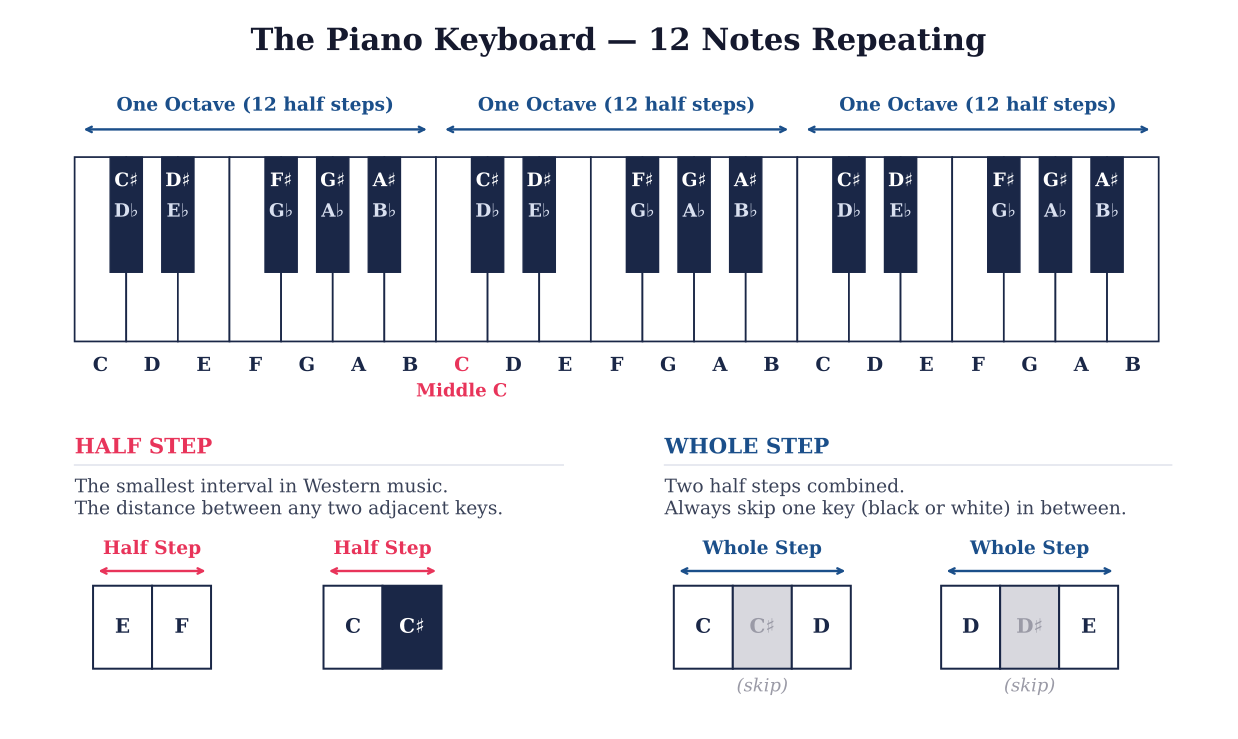
Each note represents a different fundamental frequency—a specific pitch measured in hertz. The change from one note to the very next note is called a half step (C to C♯, C♯ to D, D to D♯, E to F, B to C). Two half steps make a whole step (C to D, D to E, E to F♯). Every 12 half steps—or equivalently, every 6 whole steps—the frequency exactly doubles, and you arrive at the same note one octave higher (or lower, going the other way). It sounds like the same pitch, just up or down a register.
Look at the keyboard figure. Notice the pattern of two black keys, then three black keys, repeating over and over. C is always directly to the left of the two black keys. B is always to the right of the three black keys. An 88-key piano is not 88 separate notes—it is the same 12-note pattern repeated across seven-plus octaves. Once you see this, the keyboard stops being intimidating and starts being logical.
Choosing the right key matters more than beginners realize. A vocalist may sound completely different in two keys a minor third apart—one will sit in their chest voice, the other will push them into a strained falsetto. I have watched a singer try to record a song in their friend's key (D major) when their voice clearly wanted B. We burned an entire session on strained takes. We re-cut it in B the following week and it killed in two takes. Choose the key early, choose it for the voice, and the rest of the production gets easier.
The Reference Pitch: 440, 432, and the Rest
Those 12 notes have to be anchored to real frequencies, and the anchor the whole world agrees on is 440 Hz—the A above middle C, fixed at 440 hertz (the ISO 16 standard, often called concert pitch). Tune your A to 440 and every other note falls into place around it. It is the default in every synth, tuner, and DAW instrument, and it is why a guitar recorded in Tokyo locks perfectly with a piano sample made in Berlin.
But 440 is a convention, not a law of physics, and some artists deliberately tune away from it. The two you will be asked about are 432 Hz (a hair flatter, sometimes called “Verdi tuning” after the composer who lobbied for a lower pitch) and 444 Hz (a touch sharper and brighter). The shift is small—432 sits about 32 cents below 440, and 444 about 16 cents above—but some listeners insist a track tuned to 432 feels warmer or calmer. Real or expectation, the engineer's job is the same: deliver the sound the client hears in their head.
Doing it is easy. If the song is built from virtual instruments, set the synth's (or the DAW's) master tuning so A reads 432 or 444 instead of 440—one parameter, set before you play a note. To move already-recorded audio, pitch-shift it by the cents above. Track everything to one reference so the whole production agrees.
Where it gets murky is the claims. You will run into “healing frequencies,” the solfeggio set (396, 417, 528, 639, 741, and 852 Hz), and the famous “528 Hz miracle tone” sold as repairing DNA or resonating with the universe. (Tuning to 444 is popular in that world precisely because it puts C near 528 Hz.) Be clear-eyed: there is no scientific evidence for those physiological claims—they are a cultural and spiritual practice, not acoustics. That does not make them useless to you. Plenty of paying clients want their record at 432 or built on a solfeggio frequency, and delivering it competently is good business. Just never confuse giving a client the sound they want with endorsing a health claim you cannot support. Know the standard, know how to leave it on purpose, and know the difference between an aesthetic choice and a marketing myth.
Intervals
An interval is the distance between two notes. Half steps and whole steps are the two smallest intervals, but music uses many larger ones. Understanding intervals is the key to writing melodies and building chords—every interval has a distinct emotional quality that you can learn to recognize by ear.
Intervals come in two contexts: melodic intervals (notes played sequentially, one after the other) and harmonic intervals (notes played simultaneously, stacked together). A melodic interval is what you hear when a melody moves up or down—the step from the second to the third note of “Happy Birthday” is a major second. A harmonic interval is what you hear when two notes ring together—a major third sounds bright, a minor third sounds dark, a tritone sounds tense. Both use the same names and measurements, but the emotional impact on your ear depends entirely on context.
Each interval has a quality—perfect, major, minor, augmented, or diminished—based on how many half steps separate the two notes. Perfect intervals (unison, fourth, fifth, octave) sound stable and consonant; they form the structural bones of chord progressions. Major and minor variants of seconds, thirds, sixths, and sevenths each carry a distinct emotional fingerprint you will learn to identify instantly with practice. Train your ear by playing intervals on a piano or guitar and then singing them back—this single skill underlies every melody and chord progression you will ever write.
| Interval | Half Steps | Sound / Character | Example (from C) |
|---|---|---|---|
| Minor 2nd | 1 | Tense, dissonant (“Jaws” theme) | C to D♭ |
| Major 2nd | 2 | Neutral, like the start of a scale | C to D |
| Minor 3rd | 3 | Sad, dark. Foundation of minor chords | C to E♭ |
| Major 3rd | 4 | Happy, bright. Foundation of major chords | C to E |
| Perfect 4th | 5 | Strong, open (“Here Comes the Bride”) | C to F |
| Tritone | 6 | Tense, unstable (“Maria,” Black Sabbath) | C to F♯ |
| Perfect 5th | 7 | Powerful, stable. Basis of power chords | C to G |
| Minor 6th | 8 | Bittersweet, longing | C to A♭ |
| Major 6th | 9 | Sweet, uplifting (NBC chime) | C to A |
| Minor 7th | 10 | Bluesy, jazz-flavored | C to B♭ |
| Major 7th | 11 | Dreamy, sophisticated | C to B |
| Octave | 12 | Same note, higher or lower register | C to C |
The difference between a minor 3rd and a major 3rd is what makes a chord sound happy (major) or sad (minor). This single half-step difference is one of the most emotionally powerful tools in all of music. When you are choosing between a major and minor key for your production, you are choosing between these two intervals at the most fundamental level.
Scales
suggest a correctionPopular songs do not use all 12 notes. They are broken down into scales that typically use 7. Musical scales are sequences of ascending or descending notes used to create melodies and harmonies. They help determine the mood of a song. The two most common are major and minor—and the difference between the two is the intervals between each note.
Major and Minor
Major scales use the following intervals in half steps: 2–2–1–2–2–2–1 (or: whole, whole, half, whole, whole, whole, half). The first note in the sequence is the root note. If you choose C as the root, the next note is 2 half steps up to D, then 2 more to E, 1 more to F, 2 more to G, 2 more to A, 2 more to B, and 1 more back to C. C Major is the easiest scale to learn because it is all white keys starting at C. Major scales have a happy, bright emotional feel. The first, third, and fifth notes in the major scale combine to form a harmonic chord known as a major triad.
The natural minor scale uses the following intervals in half steps: 2–1–2–2–1–2–2 (or: whole, half, whole, whole, half, whole, whole). Starting at A as your root, the next note is 2 half steps up to B, then 1 to C, 2 to D, 2 to E, 1 to F, 2 to G, and 2 more back to A. A Minor is easy because it is all white keys starting at A. Minor scales have a sad, moody, or dark sound. The first, third, and fifth notes in the minor scale combine to form a minor triad. There are other minor scales, including the harmonic minor, which raises the seventh note of the natural minor a half step—this is what gives flamenco, Middle Eastern, and a lot of cinematic music its exotic flavor.
The Pentatonic Safety Net
The pentatonic scale is one of the most widely used scales in popular music. It contains only five notes per octave instead of seven, removing the two notes that create the most tension (the 4th and 7th degrees in major, or the 2nd and 6th in minor). The result is a scale where virtually any combination of notes sounds good together—it is almost impossible to hit a “wrong” note. The minor pentatonic is the foundation of blues, rock, and much of hip hop melody writing. If you have ever improvised on the black keys of a piano and noticed everything sounds pleasant, you were playing a pentatonic scale. The pentatonic exists in nearly every musical tradition on earth—Chinese folk music, West African melodies, Celtic fiddle tunes, Andean panpipe music—which is why it sounds instinctively “right” to listeners of any background.
As a producer, here is the practical takeaway: if you are stuck writing a melody, start with the pentatonic. It will get you to something musical faster than anything else. Once you have a strong melodic idea, add notes from the full major or minor scale to bring in color and tension. The pentatonic is your safety net—the five notes that always work.
Modes
Beyond major and minor lies a family of seven modes that share the same notes as the major scale but start on a different degree. Play all white keys from C to C and you have C Ionian (major). The same notes starting on D give you D Dorian. E to E gives Phrygian. F to F gives Lydian. G to G gives Mixolydian. A to A gives Aeolian (the natural minor). B to B gives Locrian. Each mode has a distinct character: Dorian is the sound of a lot of jazz and neo-soul (Miles Davis's So What is in Dorian). Mixolydian powers a huge amount of rock and folk—it sounds major but with a slightly bluesy seventh. Phrygian carries flamenco and metal's exotic tension. Lydian sounds bright and dreamy with a sharp fourth—film scores live there. You do not need to memorize all seven on day one, but knowing modes exist gives you a way to escape the major-minor binary when a track needs a different flavor.
Choosing a Scale
The scale is a decision you make at the very beginning of every production that affects everything downstream. It determines which notes are available, which chords can be built, and the emotional character of the entire song. Choose major and the song will lean bright and uplifting. Choose natural minor and it will lean dark and moody. Choose harmonic minor and you get an exotic, cinematic tension. I once worked with a producer who only wrote in C minor for two years because it was “safe.” I pushed him into D Dorian for a single project and he said the track unlocked something he had not been able to access. The choice is yours, but it should be intentional.
Harmonic Structure and Chord Progressions
suggest a correctionScale Degrees and Roman Numerals
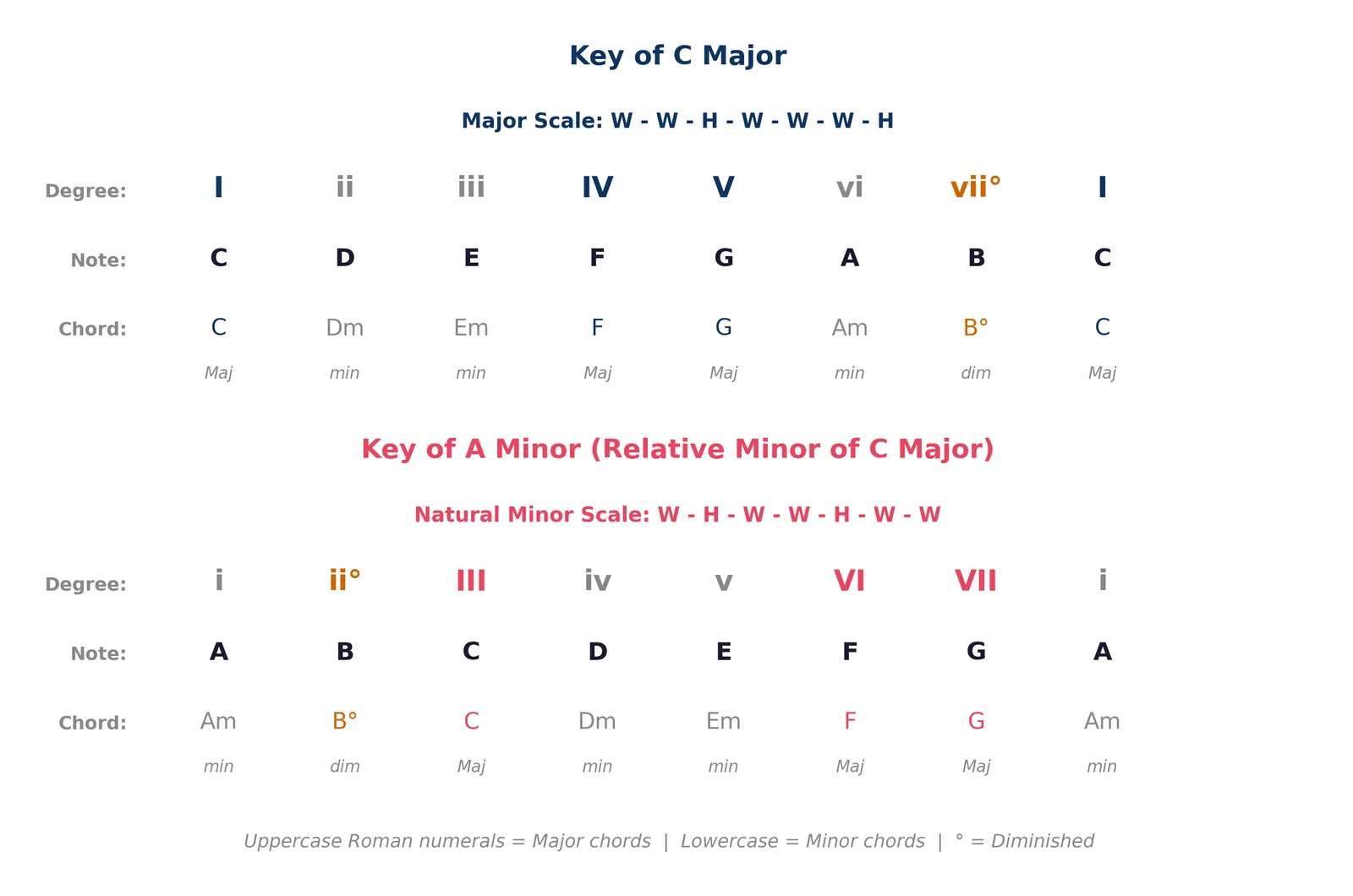
Each note in a scale is referred to by a number determined by its sequence, or degree, in the scale. The Roman numeral that goes with each degree names the chord built on that note. In the case of A Minor: A is the one (i), B is the two (ii°), C is the three (III), D is the four (iv), E is the five (v), F is the six (VI), and G is the seven (VII). Change the root and you get a completely different set of notes and relative numbers.
Just as the scale determines the notes in a song, it also establishes the chords. The only chords used in a strict diatonic arrangement are built from the seven notes of the scale. Upper-case Roman numerals indicate a major chord; lower-case indicate a minor chord; a degree symbol (°) indicates a diminished chord.
Relative Major and Minor
Both the C Major scale and the A Minor scale use the same notes, just starting on a different root. They are relative. A Minor is the relative minor to C Major, and C Major is the relative major to A Minor. In practice, the same chords are played for the C Major scale and its relative minor, A Minor. The only difference is the tonal center.
Common Progressions
A chord progression is a succession of chords played in an order for a specified duration, often harmonizing with the melody. This is the essential building block of contemporary Western music.
Below are some of the most commonly used chord progressions in popular music, shown in the key of C Major. Each one creates a different emotional feel, and learning to recognize them by ear is one of the most valuable skills a producer can develop.
I – IV – V (C – F – G)
The foundation of rock and roll. This is the simplest and most powerful progression in Western music. The three major chords create a complete harmonic journey: home (I), tension (IV), and resolution (V back to I). Nearly all 12-bar blues is built on this framework.
Songs: “La Bamba” — Ritchie Valens • “Twist and Shout” — The Beatles • “Stir It Up” — Bob Marley • “Wild Thing” — The Troggs
I – V – vi – IV (C – G – Am – F)
The most used progression in modern pop. Sometimes called the “four-chord song” or the “pop-punk progression,” this sequence has been the backbone of countless hits across every genre. It starts bright and hopeful, dips into a minor chord for emotional weight, then resolves through the IV back home. Entire comedy sketches have been built around how many songs use this exact progression.
Songs: “Let It Be” — The Beatles • “No Woman, No Cry” — Bob Marley • “Someone Like You” — Adele • “Don't Stop Believin”' — Journey • “With or Without You” — U2
vi – IV – I – V (Am – F – C – G)
The emotional/anthemic progression. This uses the same four chords as I–V–vi–IV but starts on the minor chord, giving it a more emotional or dramatic opening. It builds energy as it moves through the progression, which is why it is a favorite for choruses and hooks. Starting on the vi gives the listener an immediate sense of longing before the resolution.
Songs: “Despacito” — Luis Fonsi • “Numb” — Linkin Park • “All of Me” — John Legend • “Grenade” — Bruno Mars
I – vi – IV – V (C – Am – F – G)
The “50s progression” / doo-wop progression. One of the oldest and most recognizable patterns in popular music. The movement from I down to vi creates a gentle melancholy, then IV and V build back up. It has been used from 1950s doo-wop through modern R&B and continues to feel timeless.
Songs: “Stand by Me” — Ben E. King • “Every Breath You Take” — The Police • “Baby” — Justin Bieber • “Earth Angel” — The Penguins • “Heart and Soul” — Hoagy Carmichael
I – vi – ii – V (C – Am – Dm – G)
The jazz turnaround. This is one of the most important progressions in jazz and R&B. The ii–V movement at the end is the strongest resolution in Western harmony, and wrapping it with I–vi on the front creates a smooth, sophisticated cycle. You will hear this in jazz standards, neo-soul, and any production going for a “classy” feel.
Songs: “Blue Moon” — Rodgers & Hart
ii – V – I (Dm – G – C)
The strongest resolution in music theory. The ii–V–I is the fundamental cadence of jazz harmony. Nearly every jazz standard uses it (Levine, 1995), and understanding this movement is essential for any producer working in jazz, R&B, neo-soul, or lo-fi hip hop. The ii chord sets up the V, which resolves powerfully to the I. When you hear a chord progression that feels like it “landed” perfectly, there is a good chance a ii–V–I is responsible.
Songs: “Fly Me to the Moon” — Frank Sinatra • “Autumn Leaves” — jazz standard • “Sunday Morning” — Maroon 5
i – VII – VI – V (Am – G – F – E)
The Andalusian cadence. This progression lives in minor keys and has roots in flamenco and classical music. The descending bass line (A–G–F–E) creates a sense of dramatic inevitability. It is widely used in Latin music, rock, and pop for its dark, driving energy.
Songs: “Hit the Road Jack” — Ray Charles • “Good Vibrations” — The Beach Boys • “Sultans of Swing” — Dire Straits
Production tip: notice that many of the progressions above use the same four chords (I, IV, V, vi) in different orders. The starting chord changes everything about the emotional feel. Try playing the same four chords but starting on a different one each time—you will hear how dramatically the mood shifts. This is one of the simplest and most powerful composition techniques available to you.
I have watched a hip hop producer with a static four-bar loop completely transform a verse by sliding the same four chords into a different order. Same notes, same instruments, completely different mood. Once you can hear progressions by ear, you start hearing them everywhere—and the chord progression you are about to write is rarely as “yours” as you think. Use that. Stand on what works, then twist it.
Beyond Triads
suggest a correctionEverything in the last section was built from triads—root, third, fifth, three notes per chord. That was deliberate. Triads are the load-bearing walls of Western harmony, and if you can hear I–V–vi–IV by ear you are ahead of most beginners. But at some point every producer has the same humbling listening session. I had a producer pull up his beat next to the SZA record he was referencing and ask me why his keys sounded like a piano recital while hers sounded like silk. Same key. Similar tempo. Comparable progression. The difference, in most bars, was exactly one note per chord—the seventh. Jazz, neo-soul, gospel, and most modern R&B are not built from different progressions than the ones you just learned. They are built from the same progressions with more floors on the building. This section is those floors.
Keep Stacking Thirds: Seventh Chords
A triad is two thirds stacked on top of each other. Keep going. Add one more third from the scale—no outside notes, nothing borrowed—and you get a four-note seventh chord: root, third, fifth, seventh. Sevenths are not a separate, scarier system. They grow out of the scale exactly the way triads do, and only four qualities account for almost everything you will hear in popular music.
Major seventh (maj7) — A major triad with a major third stacked on top: Cmaj7 = C–E–G–B, a stack of 4–3–4 half steps, with the seventh sitting one half step below the octave. This is the “dreamy, sophisticated” major 7th from the interval table baked into a chord, and it is the default warmth of neo-soul and lo-fi hip hop—play one on a Rhodes and you are halfway to D'Angelo before you touch a second chord.
Dominant seventh (7) — A major triad with a minor third on top: C7 = C–E–G–B♭, stacked 4–3–3, and written with just the number—C7, G7. This is the engine of blues and gospel. The major third and the flat seventh inside it form a tritone, which is why a dominant chord refuses to sit still: it leans hard toward resolution, and it is the reason the strongest cadences in this chapter all run through V. In a major key it occurs naturally in exactly one place—on the V. Blues breaks that rule on purpose and plays dominants on everything.
Minor seventh (m7) — A minor triad with a minor seventh: Cm7 = C–E♭–G–B♭, stacked 3–4–3. This is the R&B default—rounder and smoother than a plain minor triad, melancholy with the edges sanded off. When a preset bank says “smooth keys,” it is mostly m7 chords doing the work.
Half-diminished (m7♭5) — A diminished triad with a minor seventh: Cm7♭5 = C–E♭–G♭–B♭, stacked 3–3–4. You will rarely build one from scratch at this stage, but you will meet it constantly in passing—it lives naturally on the vii of every major key and the ii of every minor key, and gospel and jazz players lean on it as the tension chord that sets up a dominant. Recognize it; do not fear it.
Here is the part that should make this feel easy rather than advanced: stack a seventh on every degree of C Major and the scale hands you the whole set—Cmaj7, Dm7, Em7, Fmaj7, G7, Am7, Bm7♭5. In Roman numerals: Imaj7, iim7, iiim7, IVmaj7, V7, vim7, viim7♭5. Nothing was imported. Every progression from the last section can be upgraded without leaving the key.
Sus and Add Chords
Not every color comes from stacking higher. Sus chords (short for suspended) swap the third out entirely: sus4 replaces it with the fourth (Csus4 = C–F–G), and sus2 replaces it with the second (Csus2 = C–D–G). With no third, the chord is neither major nor minor—it hangs in the air, unresolved. The classic move is tension and release: hold Csus4, then let the F fall a half step to E and land on plain C. That suspension-then-resolve is the oldest hook trick in pop and rock—strum it on an acoustic guitar and you are already halfway to a stadium chorus. Modern production also parks sus chords without resolving them; pads and plucked synths built on sus voicings give a track that open, floating quality precisely because the ear cannot file them as happy or sad.
Add chords do the opposite of sus: they keep the triad intact and bolt on one extra color note. The one you will actually use is add9: Cadd9 = C–E–G–D, with the D usually voiced an octave above the root. It is shimmer without commitment—the sparkle of pop ballads, acoustic intros, and melodic trap pads. The word “add” is the tell: Cadd9 has no seventh in it, while C9 does (C–E–G–B♭–D). One word on the chord label, one very different sound.
Extensions: Ninths, Elevenths, Thirteenths
If you keep stacking thirds past the seventh, you get the extensions: the 9th, 11th, and 13th—which are just the 2nd, 4th, and 6th of the scale pushed up an octave. By the time you reach a 13th you have stacked every note of a seven-note scale into a single chord, and the deeper you stack, the pickier great players get about which notes to actually keep. Here is the honest version for producers: you do not need the full jazz ladder. Extensions are color tones, and they are exactly what you are hearing in every MIDI chord pack and “lush keys” preset you have ever loaded. What you need is to hear what one extension does. Sit at a keyboard, play Cmaj7 (C–E–G–B), then add a D on top—Cmaj9. That single added note is the difference between warm and expensive; it is the quiet-storm R&B sound in one move. Learn the sound of one ninth and steal it everywhere. The chord quality underneath—maj7, dominant, m7—still does the structural work. Extensions decorate; they do not hold up the building.
Inversions and Slash Chords
So far every chord has had its root on the bottom—root position. But a chord is defined by its notes, not their order, and reordering them is called an inversion: put the third in the bass and you have a first inversion; put the fifth in the bass and you have a second inversion. On paper this is written as a slash chord: C/E (“C over E”) means a C chord with E as the lowest note—first inversion. C/G is the second inversion. The letter left of the slash is the chord; the letter right of the slash is the bass note. That is the whole notation.
Why you should care: the bass note is the note the listener's body tracks, and inversions give you control of it without changing the harmony. Move from C to F and the bass jumps a fourth. Insert the first inversion—C, C/E, F—and the bass walks C–E–F in steps instead. That walk-up is pure gospel piano. Going down works the same way: C, G/B, Am gives you a descending C–B–A bassline under chords you already know. Inversions are also your first voicing decision—a voicing being the specific vertical arrangement you choose for a chord's notes. In a modern production where the 808 or bass synth owns the low end, inversions let your keys and pads choose whichever stacking keeps the top note where the melody wants it, while the bass track defines the root. Two instruments, two jobs, one chord.
Voice Leading: Move as Little as Possible
Voice leading is the craft of getting from one chord to the next gracefully: treat every note in the chord as a separate voice, keep the common tones that the two chords share, and move everything else the shortest possible distance. The beginner MIDI habit is the opposite—copy the block chord, drag the whole thing to the next root, and watch every voice leap in parallel. That is why so many first beats sound like ringtones: the chords are right, but they jump instead of flow.
One worked example, using the progression this chapter already called the strongest resolution in music—ii–V–I in C, now with sevenths. Play Dm7 as D–F–A–C, bottom to top. To reach G7, do not jump anywhere: D and F are already in G7 (its fifth and its seventh), so leave them where they are. Drop the A a whole step to G and the C a half step to B. You are now holding D–F–G–B—every note of G7 (G–B–D–F), just re-stacked, with the fifth in the bass (G7/D, a second-inversion voicing). To resolve to Cmaj7, leave G and B alone, drop the D a whole step to C and the F a half step to E: C–E–G–B. Three chords, and no voice ever moved more than a whole step; in each change, two voices did not move at all. Hidden inside is the money move: each chord's seventh falls a half step to become the next chord's third—C, the seventh of Dm7, falls to B, the third of G7; F, the seventh of G7, falls to E, the third of Cmaj7. That falling half step is the glue in gospel, the smooth in smooth jazz, and the reason a neo-soul progression feels like it is melting from one chord into the next.
Now go back to the progressions you already know and add the floor. I–V–vi–IV becomes Cmaj7–G7–Am7–Fmaj7. The doo-wop progression becomes Cmaj7–Am7–Fmaj7–G7. The jazz turnaround was built for this treatment: Cmaj7–Am7–Dm7–G7, voice-led so the hand barely moves. Same progressions, same key, one extra note per chord—and suddenly they sound like records instead of exercises. And the next time you open a MIDI chord pack, the magic will be gone in the best possible way: those mysterious “lush” progressions are sevenths and ninths, sus voicings and inversions, voice-led so nothing jumps. You can name every trick now, which means you can play them in your own key, under your own melody, without waiting for someone else's pack to do it for you. Triads tell the listener what the chord is. Everything above the triad tells them how it feels.
The Circle of Fifths
suggest a correctionThe relative fifth (V) is the most important chord next to the one (I) because it resolves the tension created by the other chords. The figure below is called The Circle of Fifths. By following the major keys clockwise, you can determine each key's relative fifth (C→G, G→D, etc.). By following the circle counterclockwise, you can determine the relative fourth (C→F, G→C, etc.). The inner ring shows each key's relative minor.
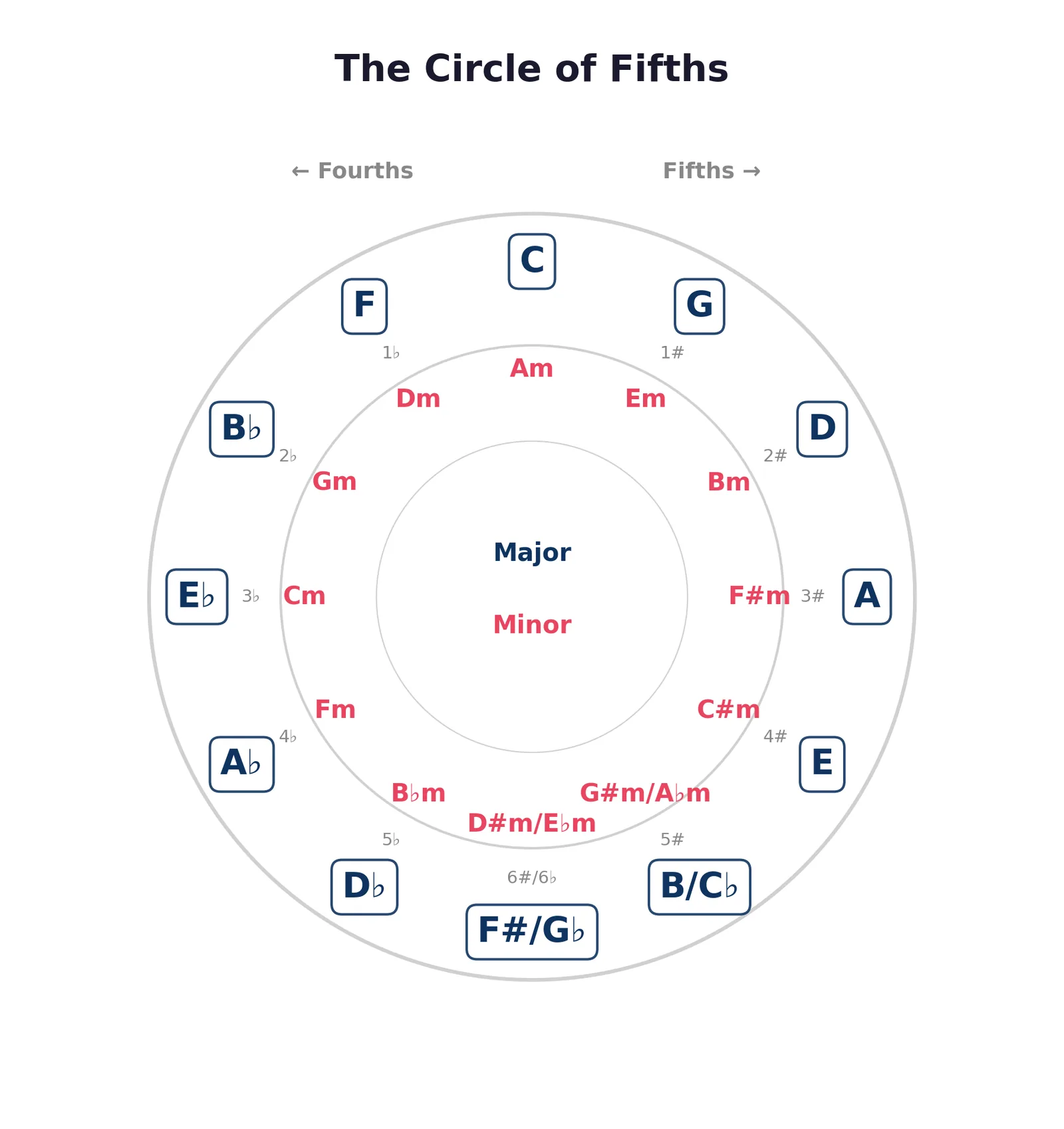
The Circle of Fifths also makes transposing easier to reason about. I once had a vocalist arrive at a session and discover they could not hit the chorus—we needed to drop the whole song into a lower key. Transposing just means moving every chord by the same interval, and the Circle keeps those relationships visible: a I–IV–V in the old key is still a I–IV–V in the new one. It is especially handy for the most common kind of key change—moving by a fourth or a fifth, which is a single step around the Circle (C to F, or C to G). For a smaller move like a whole step, you are not jumping one position on the Circle; you are shifting every chord down two notes and reading off the new key. Either way, the Circle shows you exactly where you land.
Melody Writing Basics
suggest a correction“Why a good melody should have the power to move us has thus far defied all analysis.”
—Aaron Copland, What to Listen for in Music
A great melody is often what separates a forgettable track from a hit. While melody writing is partly intuitive, there are principles that can guide the process and help you develop stronger ideas.
Stepwise motion vs. leaps. Melodies that move in small intervals (steps—moving to the next note in the scale) feel smooth and singable. Melodies with larger jumps (leaps—skipping one or more notes) create excitement and drama. The best melodies use a combination: mostly stepwise motion with occasional leaps for emotional impact. After a large leap, the melody usually steps back in the opposite direction, which is called resolution.
Repetition and variation. The most memorable melodies repeat a short phrase (called a motif) and then vary it slightly each time. Think of Beethoven's Fifth: four notes (da-da-da-DUM) repeated and transformed across the entire work. In pop music, the hook works the same way—a short, catchy phrase that gets stuck in your head because it repeats enough to be memorable but varies enough to stay interesting.
Call and response. One of the oldest musical techniques. A melodic phrase (the “call”) is followed by a contrasting phrase (the “response”). This creates a conversational feel. You hear call and response in blues, gospel, hip hop (rapper and ad-libs), EDM (build and drop), and virtually every genre. When writing melodies, try a 2-bar phrase followed by a complementary 2-bar phrase that answers it.
Vocal range considerations. If you are writing melodies for a vocalist, keep the total range within about an octave to an octave and a half. Most untrained singers have a comfortable range of roughly an octave and a half to two octaves. Place the chorus melody higher than the verse melody so the chorus feels like an emotional lift. If a singer struggles with certain notes, change the key of the song rather than forcing the performance—a natural-sounding vocal will always be more powerful than a strained one.
I have watched songwriters get stuck on a chorus melody for hours, then unstick it by moving the peak note up one whole step. Three takes later, that chorus was the one. The melody was already ninety percent there—it just needed one note pushed into a place the ear could feel as the moment.
Instrumentation
suggest a correctionInstrumentation is the combination of instruments and sounds used in a composition. Choosing the right instruments determines the distinctiveness and impact of the music. This is one of the greatest challenges a producer faces—there are hundreds of viable choices for any single track, and the same sounds quickly date a record. Producers stay relevant by constantly searching for new combinations.
A typical popular music composition consists of drums, percussion, and bass. From there, the genre and the producer's intent shape every other choice. The categories worth knowing:
Drums are the kit: kick, snare, hi-hat, toms, ride, crash. The kick and snare carry the rhythmic skeleton; everything else colors the groove. Drums are not just rhythmic—they are pitched. Every drum has a fundamental frequency, and that frequency interacts with the key of the song. A kick tuned to F sounds different against an A minor verse than a kick tuned to A. Tune your drums.
Percussion is everything else that hits: shakers, congas, bongos, tambourine, djembe, claves, cowbell, woodblock, triangle. Percussion is what makes a track feel alive. It fills the rhythmic gaps the kit leaves open and adds movement at the high end where the ear is most sensitive to motion. A bare kit feels skeletal; the same kit with a shaker on the offbeats and a tambourine on the chorus suddenly breathes. Most percussion lives in a higher frequency range than the kit, which is exactly why it sits on top without fighting the kick or snare. The first time I added a tight shaker pattern to a verse that had been feeling flat, the whole arrangement woke up—no other change, just one layer of motion.
String instruments (violin, cello, viola, double bass, acoustic and electric guitar, bass guitar, harp, banjo, mandolin, ukulele, harpsichord, and the acoustic piano—yes, technically a string instrument, since hammers strike its strings) cover almost the entire frequency spectrum and form the harmonic core of most arrangements. They can carry rhythm, melody, and harmony at once, which is why a single guitar or piano can hold a whole song together.
Wind instruments (saxophone, clarinet, flute, piccolo, oboe, recorder, plus free-reed and pipe instruments like harmonica, accordion, and pipe organ) add expressive, breath-shaped melody lines and tend to sit in the upper midrange. Because they're driven by human breath, they bend pitch and dynamics in ways that are hard to fake with samples—which is exactly why a real horn or harmonica line can lift a track.
Brass (trumpet, trombone, French horn, tuba) brings power and weight. A horn section is how a record announces itself—think of the stabs in funk, soul, and ska. Even a single muted trumpet can define the mood of a ballad. Brass cuts through a dense mix better than almost anything, so a little goes a long way.
Synthesizers can be anything: a bass, a lead, a pad, an arpeggio, an ambient texture, a sound-design effect. They are the most flexible instrument family in modern production—capable of imitating acoustic instruments or producing sounds that exist nowhere in nature. In most contemporary genres, the synth is the single most-used sound source.
Vocals (lead, backgrounds, choir, beatbox, chant) carry the song's identity and its lyrics—for most listeners, the voice is the song. Backgrounds and harmonies widen and thicken the chorus; ad-libs add personality and motion. No instrument commands a listener's attention like the human voice, which is why so much of mixing is built around protecting it.
Sound effects (crowd, applause, riser, impact, foley, vinyl crackle, white-noise sweeps) shape the listener's expectations and guide them through the arrangement. A riser builds tension into a drop; an impact marks the downbeat of a chorus; a touch of vinyl crackle sets a lo-fi mood before a single note plays.
Because each instrument occupies a specific frequency range, do not pile too many instruments into the same range. Instruments that overlap in frequency fight each other and lose definition—two acoustic guitars and a piano and a Rhodes all in the same midrange will turn into mud no matter how well any one of them is recorded.
Drums and percussion are typically thought of as purely rhythmic, but they carry strong tonal qualities, and that is why your percussion needs to be tuned to the key of the song. Kick and snare drums are especially important and tend to fit best in a mix when their fundamental sits in or close to the key. With a live kit, tuning means tightening or loosening the drumhead until it reaches a target frequency. With drum samples, tuning is a matter of transposing the sample or using a plugin like Melodyne.
The rhythm of percussion in particular is where “swing notes” or “shuffle notes” do their work—notes with equal written time values performed with unequal durations, usually as alternating long-short. The amount of swing varies by tempo, genre, and the player's taste, from almost equal (typical at fast tempos) to nearly a full shuffle (typical at slow tempos). It is the single most important variable in whether your percussion grooves or feels like a click track.
Dynamics
suggest a correctionDynamics refer to how loud or soft the music is at any given moment. Dynamic variation is what gives music its emotional shape—without it, even the best melody and chord progression will sound flat and lifeless. Learning to control dynamics is essential for both composition and production.
| Marking | Meaning |
|---|---|
| pp (pianissimo) | Very soft |
| p (piano) | Soft |
| mp (mezzo piano) | Moderately soft |
| mf (mezzo forte) | Moderately loud |
| f (forte) | Loud |
| ff (fortissimo) | Very loud |
| Crescendo | Gradually getting louder |
| Decrescendo (diminuendo) | Gradually getting softer |
In the context of modern production, dynamics are controlled through several tools. Velocity in MIDI determines how hard a virtual instrument is “played”—higher velocity means louder and often brighter tone (MIDI 1.0). The first time I programmed a hi-hat pattern with every note at velocity 127, the result sounded robotic, mechanical, dead. Pulling individual hits down into the 70–110 range and varying them note-to-note made the same pattern feel like a human played it. Automation allows you to draw volume changes over time, creating crescendos and decrescendos within your DAW. Together, velocity and automation are how dynamics happen in modern production.
Song Structure
suggest a correctionUnderstanding song structure is one of the most important skills a producer can develop. Song structure (also called song form) is the arrangement of sections within a composition. While there are no hard rules, most popular music follows predictable patterns that listeners have come to expect. These patterns exist because they work—they create familiarity, build anticipation, and deliver emotional payoffs at the right moments.
Song Sections
A song moves through a sequence of sections that each play a specific role. Walk through them in order and the architecture becomes clear.
The intro sets the mood and pulls the listener in. Anywhere from 2 to 16 bars, it usually establishes the key, tempo, and main sonic palette before the vocals enter. Strong intros hook the listener within the first few seconds—critical in the streaming era, where listeners skip in single digits. In fact, many modern records barely have an intro at all: a single drum fill, an 808 slide, a half-bar vocal chop, and you're already in the first verse. When attention spans are measured in seconds, getting to the hook fast is often the smartest intro of all.
The verse tells the story. Verses carry the narrative, with different lyrics each time the section appears. Musically, they tend to sit lower in energy than choruses, which is what creates the contrast that makes the chorus feel like a lift. Most verses are 8 or 16 bars.
The pre-chorus builds anticipation before the chorus—rising energy, often a chord change or melodic shift that signals something bigger is coming. Not every song has one, but a well-crafted pre-chorus makes the chorus hit harder. Typically 4–8 bars.
The chorus is the emotional peak and the most memorable part of the song. The chorus usually contains the hook—the catchy, repeating melody or phrase that listeners remember. Choruses are typically louder, fuller, and more energetic than verses. Most are 8 bars, and the lyrics stay the same each time the chorus repeats.
The post-chorus is a short section that lands right after the chorus and extends its energy before the song moves on. It's often a hook in its own right—a wordless “oh-oh” refrain, a vocal chop, or a beat-driven instrumental tag—giving the catchiest part of the song a second place to live. Once mainly an EDM and pop device, the post-chorus now turns up across nearly every genre. Typically 4–8 bars.
The bridge provides relief from repetition. It usually appears once, after the second chorus, and introduces new melodic, harmonic, or lyrical material. Its purpose is to keep the song from feeling predictable before the final chorus. Most bridges are 8 bars.
The outro closes the song. It can be a fade-out, a final chorus repetition, a return to the intro, or a completely new section. The outro gives the listener a sense of resolution—or, deliberately, an unresolved feeling.
In modern hip hop and EDM, you may also encounter a drop (the moment when the beat kicks in after a buildup, common in EDM and trap), a breakdown (a stripped-down section that creates tension before the drop), and an ad-lib section or tag (repeated vocal phrases layered over the beat).
I have skipped the bridge to “make the song shorter” and watched the third chorus arrive without anywhere to land. Put the bridge back, and the chorus felt earned again. Bridges exist for a reason—listeners need a release valve before the final payoff.
Common Song Structures
Different genres lean on different architectures. The five you should recognize on sight:
Verse–Chorus (ABAB). Verse, Chorus, Verse, Chorus. Simple and direct. Common in folk, country, and punk—when the song is the song and embellishment would kill it.
Verse–Chorus–Bridge (ABABCB). Verse, Chorus, Verse, Chorus, Bridge, Chorus. The most popular structure in modern pop, R&B, and rock. The bridge after the second chorus keeps things fresh before the final payoff.
AABA (32-bar form). A classic jazz and Tin Pan Alley structure. The A sections carry the main theme, and the B section (the bridge, or “middle eight”) provides contrast. Still alive in modern ballads.
Verse–Hook (Hip Hop). Verse, Hook, Verse, Hook, Verse, Hook. The hook fills the same structural role as a chorus—the memorable, repeating centerpiece—but the two terms carry a different emphasis. A “chorus” usually means a fuller, sung section that is the song's emotional peak; a “hook” is the catchy phrase itself, often shorter, more repetitive, and as likely to be rapped or chanted over the beat as sung. In hip hop the hook is frequently built on a single melodic or rhythmic phrase that loops, and it carries the song's identity the way a chorus does in pop. Typically 8 bars. This is the dominant structure in hip hop and rap.
Build–Drop (EDM). Intro, Build, Drop, Breakdown, Build, Drop, Outro. The emotional architecture is built around tension and release rather than lyrical storytelling.
At the arrangement level, dynamics also come from adding and removing instruments. A verse with just vocals and guitar feels soft; adding drums, bass, and strings for the chorus creates a dramatic dynamic shift even before any volume changes. This is called arrangement dynamics, and it is one of the most powerful tools available to a producer. Think about the quiet verse / loud chorus structure of “Smells Like Teen Spirit” by Nirvana—the dynamic contrast is what makes the chorus explosive.
Production tip: before you start producing, map out your song structure on paper or in your DAW using empty markers. Decide how many bars each section will be. This gives you a roadmap so you are not just building loops—you are building a song. Tools like Hooktheory (hooktheory.com) are excellent for composing arrangements—you can search for any popular song to find its key, tempo, and chord progression, then export the MIDI and import it into your DAW. Other useful tools include Splice (splice.com) for samples and presets, and the free browser-based tools at musictheory.net for learning fundamentals.
Learn the Rules, Then Break Them
suggest a correction“Without deviation from the norm, progress is not possible.”
—Frank Zappa, The Real Frank Zappa Book
Music theory is not a set of rules you have to follow—it is a language that helps you understand why certain combinations of notes, rhythms and structures make people feel something. The more fluent you become in that language, the faster you can turn the sounds in your head into finished music.
Remember those Fruity Loops sessions—no saving, no theory, just moving notes around until something clicked? Everything in this chapter is what we were stumbling toward in those late-night experiments: why certain notes sound good together, why a snare on 2 and 4 makes your head nod, why starting a progression on the vi chord makes the whole song feel different. The theory does not replace the experimenting—it accelerates it. Learn the rules, then break whatever rules you want. But break them on purpose, not by accident.
Review Questions
Work these before moving on — every question is answerable from this chapter. Written answers live in the instructor Answer Key, available to course adopters.
- Define the following terms: Music, Rhythm, Melody, Harmony, Tempo.
- How is tempo measured?
- How many beats are there in a 4/4 time signature? How many in a 3/4 time signature, and what feel is associated with each?
- What is a dotted note, and how does the dot affect its duration?
- Our modern tuning system has how many notes?
- What is the difference between a half step and a whole step? Give an example of each.
- Compare the interval sequences of a major scale and a natural minor scale, in whole and half steps. Give an example key for each.
- What is a chord progression? Name two commonly used chord progressions and list a song that uses each.
- What is the relative minor of C Major? Explain why they are considered “relative.”
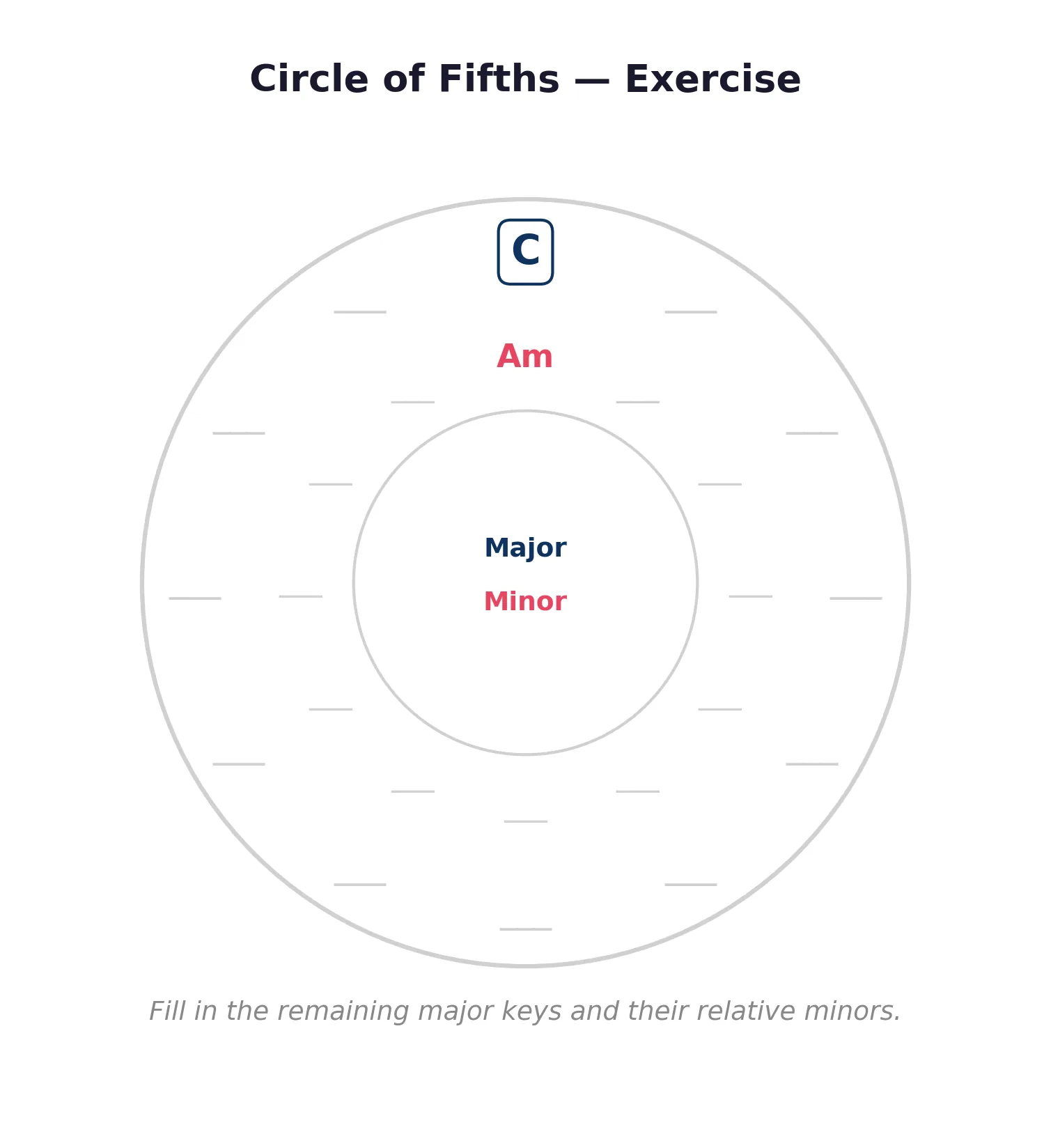
- Fill in the Circle of Fifths below, including the relative minor keys. The first one (C / Am) has been done for you.
- Figure out the list of notes and chords in an F♯ Minor scale, then pick a chord progression.
- What is instrumentation? List some instruments you would like to use in a music production and explain why.
- Research a popular song and find its tempo, scale, key, meter, chord progression and instrumentation. You may use Hooktheory or similar tools.
- Name and describe the main sections of a song (at least five), and identify the most common song structure in modern pop using those section names.
- What is the difference between a minor 3rd and a major 3rd? How does this difference affect whether a chord sounds happy or sad?
- Explain the difference between straight feel and swing feel. Name a genre that commonly uses each.
- What is syncopation? Give an example of how it is used in a genre of your choice.
- Name three common drum patterns and describe the genre each is associated with.
- What are dynamics in music? Explain the difference between volume dynamics and arrangement dynamics, and give an example of each.
- What is call and response? Name a genre that commonly uses this technique.
- Why is it important to consider a vocalist's range when writing a melody? What should you do if a singer struggles with certain notes?
- What does it mean for a groove to be “in the pocket”?
- What is a mode? Name a mode other than Ionian (major) or Aeolian (natural minor) and describe its character.
- What is polyrhythm? Give an example of where you might hear it.
- What is a seventh chord? Spell Cmaj7 and Dm7, and name one genre where seventh chords are the default harmonic color.
- What is voice leading? Using the progression Dm7 to G7 to Cmaj7, describe how the chord tones can move as little as possible.
- What is a slash chord? What does C/E tell the bass player, and how does it differ from a plain C major triad?
- The chapter states that reordering the same four chords can “dramatically” shift the emotional feel of a progression. Using the chords I, V, vi, and IV (in C Major: C, G, Am, F), write out three different orderings and evaluate how the starting chord changes what the listener feels. Which ordering would you choose for a chorus that needs to feel anthemic and urgent, and why?
Studio Exercise: Compose an Eight-Bar Foundation
The goal of this exercise is to make every theory choice in this chapter intentional. You are going to compose an eight-bar musical foundation that will become the seed for your Chapter 13 production project. By the end of this assignment you should have a MIDI file you can import into any DAW, with documented choices for every layer of the music.
Required:
- Tempo. Pick a BPM. Justify it against the genre you intend to produce and the feel you want.
- Key and scale. Pick a key (e.g., A Minor, F♯ Major, D Dorian). Justify it against the emotional character you are going for and, if you have a singer in mind, their vocal range.
- Time signature. Most likely 4/4. If you choose 3/4 or 6/8, justify why.
- Chord progression. Compose at least eight bars in your chosen key, using chords from the scale. Use one of the common progressions in this chapter or compose your own.
- Three target reference tracks. Pick three released songs in the same approximate tempo, key (or relative key), and genre that your composition is aiming at.
- Export MIDI. Use Hooktheory, your DAW, or any tool that exports a standard MIDI file. This file becomes the seed for your Ch 13 production.
Optional:
- Add an eight-bar melody on top of the progression, written from the same scale.
- Choose two contrasting drum patterns from this chapter and program eight bars of each over your progression. Compare which feels right against the chord changes.
- Transpose the progression up a step and down a step using the Circle of Fifths. Listen to all three versions. Which one suits the intended vocal range?
Deliverable: A MIDI file plus a one-page document covering all six required choices, the three reference tracks, and a 100-word reflection on which choices were easiest and which were hardest. Bring this MIDI file into your Chapter 13 production project—you will build a full arrangement on top of this foundation.