Chapter 1 · Foundations
The Studio and Its Players
“Talent is cheaper than table salt. What separates the talented individual from the successful one is a lot of hard work.”
—Stephen King
By the end of this chapter, you will be able to:
- Identify the four core studio roles—artist, producer, engineer, and songwriter—and explain how each depends on the others to bring a recording to completion
- Distinguish studio performance from live performance and explain why the studio environment demands a separate discipline from the artist
- Describe what a music producer actually does across the creative phase, from song selection through mastering, and explain why taste is the producer's core qualification
- Compare the three engineering specializations—studio, post-production, and live sound—and describe the primary responsibilities that define each
- Explain why the song is the foundation of every record and how the songwriter's work determines the ceiling for everything else in production, engineering, and performance
- Identify the key members of the wider business team behind a record—manager, A&R, label, publisher, performing rights organization (PRO), and entertainment lawyer—and describe the function each serves
- Explain why the modern audio professional must be multi-disciplinary and describe the strategy of combining a primary skill with adjacent competencies to remain competitive and consistently booked
- Apply a principled framework for using AI tools in the studio—selecting AI where it serves the work while retaining personal taste and judgment as the final authority
- Identify the five physical spaces of a professional studio—control room, live room, iso booth, machine room, and lounge—and describe how the talkback, cue-mix, and tie-line systems connect them into a working whole
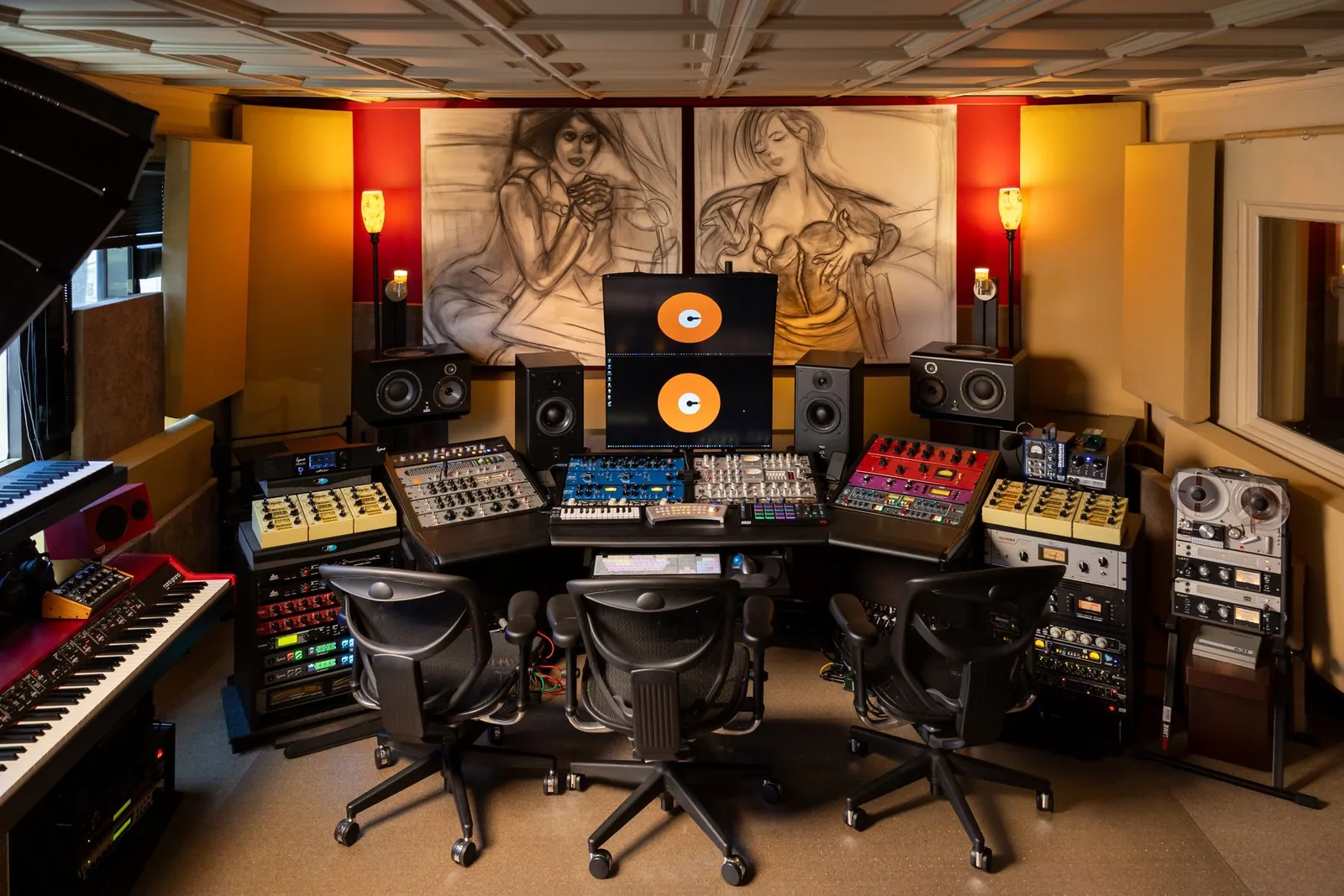
I started in a closet. Literally. My dorm room at Denison University had a small walk-in closet. My roommates and I hung blankets on the walls, set up a cheap microphone, installed a demo copy of Fruity Loops, and started recording. We had no training, no gear budget, no idea what we were doing. But I had a sound in my head and an obsession with figuring out how to get it out of the speakers.
After graduation I moved to California with nothing but a dream that sounded ridiculous to everyone but Mom and me. My employer offered me an unused office, and in 2005 The OC Recording Company opened its doors—minimal gear, few contacts, and an engineer who was still learning on the job. My first client was a rapper from Boston who had just moved to Orange County. Together we produced his records, which featured AZ and Royce da 5'9” as guests. He landed a deal, and word started to spread. Within two years I was booked weeks out, reinvesting every dollar back into the studio.
Since then I have had the privilege of working with Grammy-winning and Platinum-selling artists, scoring an award-winning film, earning a gold record and a U.S. patent, passing the California Bar Exam, and building a recording school that has trained hundreds of students. None of it started with connections or money. It started in a closet with blankets on the walls.
I tell you this not to impress you, but to make a point: every studio you have ever admired started as an empty room with one person who refused to quit. The gear will come. The clients will come. The skills will come. But only if you show up, every day, and put in the work. This book is the roadmap I wish I had when I was hanging blankets in that closet.
The accolades and the income are never what make the work worth doing. Records follow you forever. Each session leaves you sharper than the last. Lives are touched in ways you may never even know. And the days themselves don't feel like work—you look up at 3 AM, wondering where the night went, and you cannot wait to do it again tomorrow. I knew early on that I didn't want to look back one day and wonder what would have happened if I had gone for it—so I went. No safety net, no plan B. Whatever path you choose in life, choose the one whose work you would be proud to leave behind.
This path begins by understanding the people who make every record happen—the artist, the producer, the engineer, the songwriter, and the team around them. Each role depends on the others. A weak song undercuts the producer's vision. A weak performance gives the engineer nothing to work with. A weak engineer loses the song. Bedroom studio or flagship room, the players don't change—and neither does the chain that links them.
A Tour of the Studio
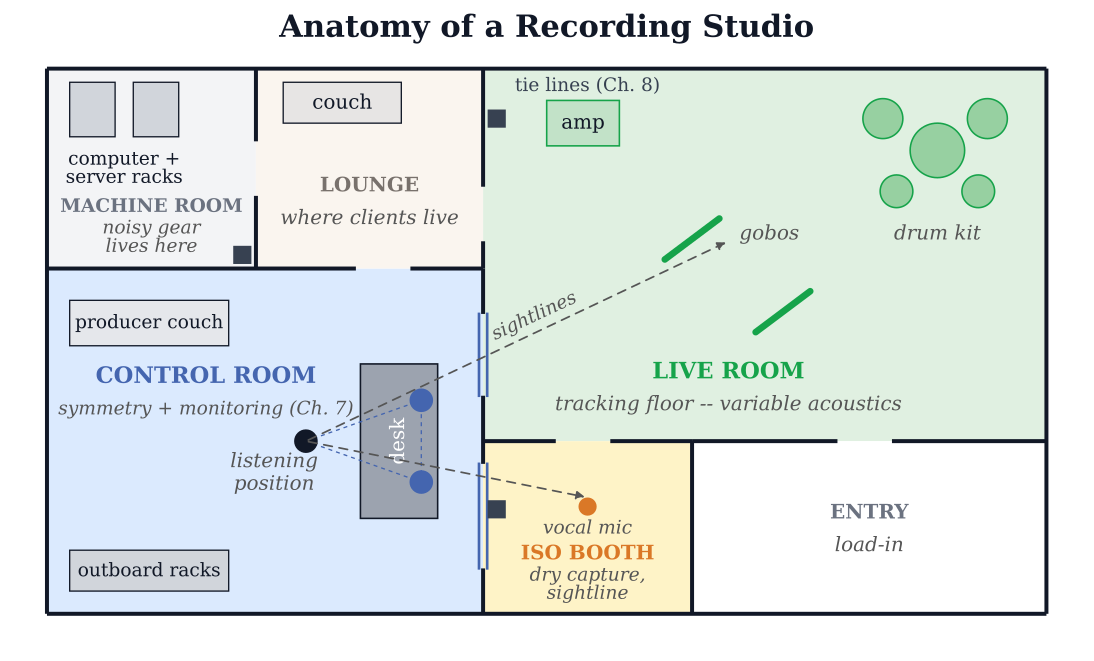
suggest a correctionBefore we meet the people, take a walk through the building. The chapter title promises a studio, and you have not seen one yet—so here it is. Whether you are standing in a 10,000-square-foot commercial room or a converted bedroom, every professional recording space is solving the same problem: how do you keep the right sounds in, the wrong sounds out, and the right people hearing what they need to hear? The rooms that follow are the answer.
The Control Room
The control room is where the engineer works and where decisions get made. Its defining feature is not the desk or the racks—it is the listening position. The engineer's chair sits at the precise geometric center between the two monitor speakers because symmetry is what makes monitoring reliable. Move a foot to the left and the stereo image shifts; move a foot forward and the bass changes. Every mix decision—every EQ curve, every level call, every panning choice—is made from that one spot because it is the only spot in the room calibrated to tell the truth (Toole, 2018). We cover why in Chapter 7, where room acoustics and monitor placement get the full treatment they deserve.
Around that listening position: the mixing console or a DAW controller sitting in front of the monitors, the audio interface running converters, outboard gear in the racks on either side (preamps, compressors, EQs), and the patchbay—that wall of quarter-inch jacks that lets you connect any piece of gear to any other with a single short cable. Behind the desk, wall panels bring tie lines in from every room in the building. Chapter 8 covers the patchbay and the cabling nervous system in depth.
The Live Room and Tracking Room
The live room (sometimes called the tracking room) is where the microphones go and where performances happen. Size is the first variable: a large live room can hold a full drum kit, a piano, and a string quartet at the same time, and its physical volume creates natural room sound that becomes part of the recording. A smaller room is tighter and more focused—better for drums that need punch rather than bloom, or guitars that need edge rather than air. Ceiling height matters just as much as footprint: a low ceiling compresses the room's low-frequency modes and changes how the room sounds on overhead microphones. High ceilings open up.
Most serious live rooms are variable-acoustic—they have sections of absorbent wall panels that can be opened or closed to adjust how live or dead the room sounds. A drummer tracking a rock record wants the room alive; a guitarist tracking jazz might want it drier. The room itself is a variable. Gobos—freestanding baffles, typically two-sided with an absorptive face and a reflective face—extend that variability: you can arrange them around a drum kit to tighten the overheads, surround an amplifier to control bleed, or create a makeshift booth anywhere on the floor.
The Iso Booth and Vocal Booth
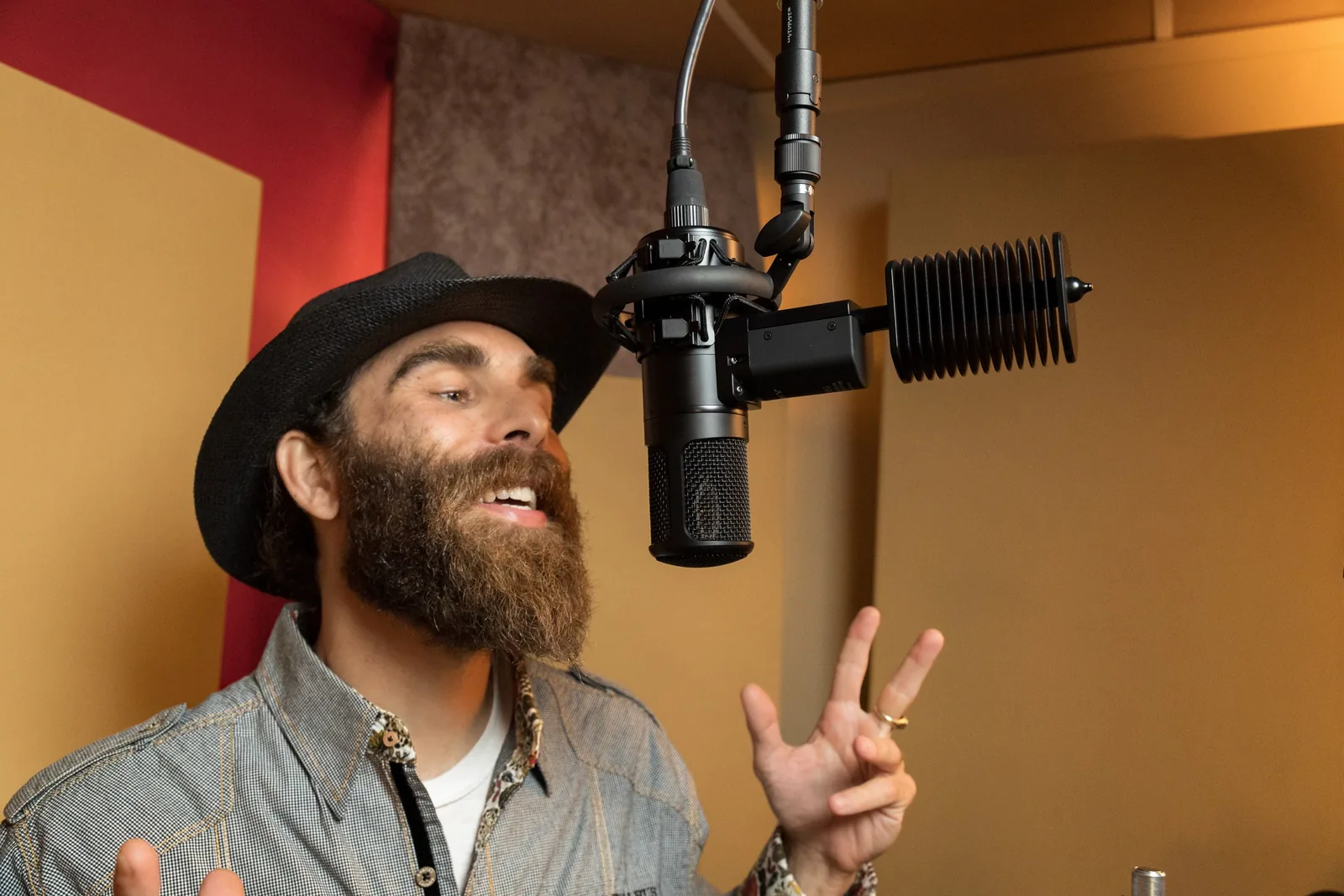
The isolation booth (or vocal booth) is the small, acoustically dead room off the live room. Its purpose is dry capture: a vocal, a voiceover, a solo instrument—anything where you want the microphone to hear the performance and nothing but the performance, with no room ambience. Treatments are heavy here by design. The dryness that feels suffocating to stand in sounds clean and controllable on a recording; you can always add reverb and space in the mix, but you cannot remove a room you printed.
The other critical feature of a good iso booth is the sightline to the control room. The engineer and the vocalist need to see each other. A vocalist performing behind glass with a clear view of the producer and engineer is connected to the session; the same vocalist staring at a blank wall is performing alone. The glass is the bridge—and it is why even the smallest professional booth has a window.
The Machine Room and Amp Room
Not everything in a recording session should be in the same room as the microphone. The machine room (sometimes called the amp room) solves a fundamental problem: loud things and spinning things are the enemies of a quiet noise floor. A guitar amplifier cranked to the edge of breakup produces tremendous volume—useful for the tone, catastrophic for any other microphone in the same space. A server rack, a tape machine, and a wall of hard drives each produce a continuous mechanical noise floor. The solution in any serious facility is a separate room behind the wall: amplifiers mic'd through a panel, machines running out of earshot, and the studio's noise floor kept as low as physics allows. Long cable runs from the amp room back to the patchbay are a reasonable trade for a clean recording environment.
The Lounge
The lounge is the most underrated room in the building, and the most overlooked in textbooks. Clients spend a large part of every session day here—waiting for a take to be set up, decompressing between passes, eating, talking. The energy in the lounge at three in the afternoon determines the energy in the booth at four. A comfortable couch, good food, somewhere for a phone to charge, a television that is not too loud—these are not amenities. They are session management. A client who feels at home stays relaxed, trusts the process, and brings better takes. A client who is uncomfortable starts watching the clock. I have saved sessions from falling apart with a cup of tea and twenty minutes in the lounge. You will too.
The Nervous System: Talkback, Cue Mixes, and Tie Lines
What connects all of these rooms is not the walls—it is the communication system running through them. Talkback is the intercom between the control room and the live room: the engineer presses a button and speaks into a small microphone mounted on the console or desk, the performer hears them through the headphones or the room monitors. Without a reliable talkback path, every note of direction becomes a trip through the glass door.
The cue mix is the headphone mix the performer hears while tracking. It is not the mix—it is a custom blend built specifically for the performer's comfort and focus. A drummer wants the click louder and the guitars softer. A vocalist wants more of their own voice, less of the drums, and some reverb on their headphone return so the dry booth does not feel clinical. Cue mixes are not a luxury; they are the difference between a great take and a nervous one. Chapter 12 covers building them in detail.
Wall panels and tie lines are the studio's infrastructure layer: XLR and TRS jacks recessed into the walls of every room, wired back to the patchbay in the control room. A microphone in the live room plugs into a wall panel; that signal appears at the patchbay, where it can be routed to any preamp, any converter input, any recorder. Tie lines are why a professional studio can reconfigure its entire signal flow in minutes instead of running new cable across the floor for every session. Chapter 8 has the full picture.
One Room Playing Every Role
Most of you are not starting in a commercial facility—you are starting in a bedroom, a garage, or a basement. That is exactly where this book was written, and it is exactly where most of the records you love were made. The principles above still apply; the difference is that your single room is playing every role at once.
When you have one room, prioritize in this order: monitoring first. Your listening position must be symmetrical between your speakers, and the worst low-frequency problems must be controlled—bass traps in the corners are the highest-return acoustic investment you can make (Senior, 2025). Separation second: a moving blanket draped over a microphone stand is a gobo; a closet stuffed with clothes is an iso booth. You are solving the same problems a commercial room solves—you are just solving them with ingenuity instead of architecture. Communication third: once another human is in your space, you need a way to talk to them while they are wearing headphones. A simple talkback channel costs nothing to configure in your DAW.
The building does not make the record. The decisions made inside it do. But understanding why a professional room is built the way it is makes you better at making those decisions in any room you ever work in—including the one you are in right now.
The Artist
suggest a correction“If you find a tune and it's got something to do with you, you don't have to evolve anything. You just feel it, and when you sing it other people can feel something too.”
—Billie Holiday, Lady Sings the Blues (1956)
I have seen a vocalist with no formal training walk into the booth and deliver a take so raw and honest that every person in the control room stopped talking. I have also seen classically trained singers freeze up because the headphone mix was wrong. The difference between a great session and a disaster often has nothing to do with talent. It comes down to two things: how the artist prepared before they walked in, and the environment built around them once they did. The artist who knows the lyrics cold, warmed up the voice, slept the night before, and showed up ready to work has already won half the battle. Everyone else in the room decides the other half—the engineer's headphone mix, the producer's tone of voice between takes, the strength of the song the writers brought in, even the room itself.
The job of the artist, band, or musician in the studio is to deliver a strong performance. That doesn't require theoretical knowledge—it requires the ability to translate emotion into sound, the discipline to stay focused take after take, and the humility to accept direction and constructive criticism without taking it personally.
Studio vs. Stage
Studio performance is its own discipline. On stage, you have one take and an audience to feed off—the energy of the room covers a lot of small mistakes and pulls the performance forward. In the booth, you have to deliver the same emotion on take 17 that you delivered on take 1, alone behind a glass wall, with no audience and no adrenaline. Singers who kill it live sometimes freeze in the studio. Vocalists who are unremarkable on stage sometimes deliver the take that defines a record. The studio is a microscope. On a stage, the PA, the crowd, and the adrenaline of the moment mask a thousand small imperfections—a flat note, a rushed entrance, a buzz on a string. In the studio there is nowhere to hide: you put every detail under magnification on studio monitors in a silent room, and what was invisible on stage is suddenly the only thing you can hear. That is the discipline of recording—and the reason a great live performer is not automatically a great studio performer.
I once worked with a vocalist who had filled venues for a decade and could not make it through a chorus in the booth. We took the lights down, killed the talkback to the rest of the band, and treated the room like a private moment between her and the song. We got the take in two passes. The trick was not trying to make the booth feel like a stage—it was leaning into what the booth actually is: a quiet room where one human can be alone with a song. Artists who learn that go from making demos to making records. Engineers and producers who learn it are the ones who get the take when the artist cannot find it on their own.
On Both Sides of the Glass
This book will not focus on the craft of the artist. However, I do recommend that all engineers and producers have experience as one. By being an artist, you understand the small things that inspire better takes—the headphone mix, the room temperature, the time of day, the words you say between takes, even the humidity in the air. I have stopped sessions to fetch tea, to lower the AC by two degrees, to clear everyone but the artist out of the room. Those moves are not optional—they are the job. And I know they are the job because I have been on the other side of the glass myself, hoping someone would notice. We cover all of it in Chapter 12, where the recording workflow lives.
The Producer
suggest a correction“I'm a producer at heart. I like being in the control room and directing people. That's what I do.”
—Dr. Dre
The first time a producer told me to scrap an entire day's work and start the beat over from scratch, I thought he was out of his mind. By the end of the session, the new version was ten times better. That is the producer's job—to hear the finished record before it exists and make the hard calls that get everyone there.
How the Role Came to Be
Before the 1950s, A&R (Artist and Repertoire) reps at the labels picked the songs, songwriters wrote them, and the engineer cut the disc. There was no producer in the modern sense. Magnetic tape changed that. Studios got cheaper to build, A&R execs and songwriters broke away to start their own production companies, and by the late 1950s the independent producer was a thing—a creative force sitting between the artist and the label.
In the 1960s, multitrack recording transformed how records got made. The goal was no longer to capture a live performance; producers could now manipulate sound to an unprecedented degree, and the producer became a creative force in their own right. George Martin shaped the Beatles' sound across every record. Phil Spector built the Wall of Sound. And artists like Brian Wilson of the Beach Boys (Pet Sounds, 1966)—and later Stevie Wonder and Marvin Gaye—became their own producers.
What the Producer Does Today
The music producer directs the creative phase from start to finish—gathering ideas, selecting songs and musicians, coaching the artist in the studio, running the sessions, and supervising the project through mixing and mastering. The executive producer sits a level above on the business side: financing the project, managing the budget, and protecting the label or investor's interests. Most working artists never see the executive producer; the music producer is the one in the room with them every day.
A note on terminology: “producer” means something different in film. In movies, the producer is typically the financier who organizes and funds the project, while the creative-leader role belongs to the director. A film producer is closer to a music executive producer; the film director is closer to a music producer. Same word, two different jobs.
Genre Differences
The term “producer” can mean different things across genres. In hip-hop, R&B and pop music, the producer is generally the person composing the beat or instrumental. In rock, country and some pop music, the producer doesn't necessarily write the music but instead gives the band input on how to play certain parts, coaches the vocalist, and is the final word on whether a take stays or goes. In the post-production world, a producer can take the role of a composer and create original music for film—called film scoring. In hip-hop especially, the producer is often also the engineer—building the beat, directing the takes, shaping the vision of the song, recording the vocals, and mixing the track without ever leaving the same chair.
Whatever the genre, the producer is responsible for evaluating performance and song quality on the spot—we cover the specific criteria in Chapter 14 when you start comping your own takes. In film scoring specifically, the producer-as-composer needs music theory chops, instrumental knowledge, and a feel for what fits the picture.
Taste Is the Job
Rick Rubin—one of the most successful producers alive, who has worked with everyone from Johnny Cash to Jay-Z to Adele—told Anderson Cooper on 60 Minutes in 2023, “I have no technical ability. And I know nothing about music.” When Cooper asked what he was being paid for, Rubin said “the confidence that I have in my taste and my ability to express what I feel has proven helpful for artists.” Hard to say it better than that. The technical work happens around them; what the producer brings is taste and the conviction to act on it.
I have made the same kind of call in my own room. Years back, I told an artist to cut the second verse of a song they had been writing for months. They were furious. The shorter version went to radio and changed their career. That call had nothing to do with knobs or beats. The producer's job is knowing what to keep and what to lose—and being willing to be wrong out loud.
The Engineer
suggest a correction“If you had a sign above every studio door saying ‘This Studio Is a Musical Instrument' it would make such a different approach to recording.”
—Brian Eno
I once watched an experienced engineer fix a mix that three other people had given up on. He did not add a single plugin. He adjusted the gain staging, fixed a phase issue on the bass, and high-passed three tracks that were cluttering the low end. The whole thing took fifteen minutes—the difference between knowing the tools and understanding what they are actually doing.
From Technician to Co-Author
In the 1960s, engineering was a staff trade. Studios like Abbey Road, Capitol, and Columbia hired engineers as employees, often required them to wear white lab coats, and apprenticed them up from tape op to assistant to first engineer over years. The role was technical: run the tape machines, set the levels, execute the producer's vision. The gear filled rooms, sessions cost a fortune, and only labels and signed artists could afford to make records.
As technology evolved through the 1960s and 70s, the role expanded. Bruce Swedien shaped Michael Jackson's records alongside Quincy Jones. Eddie Kramer captured Hendrix and Led Zeppelin. Bob Clearmountain made mixes that defined a generation. The engineer stopped being just a button-pusher and became a creative voice in their own right.
Today, the work happens in flagship rooms, in home studios, and on laptops anywhere there is power and an interface. Modern engineers like Serban Ghenea, Manny Marroquin, and Leslie Brathwaite mix global hits the same week they teach the craft on YouTube and Pensado's Place. The line between “technician” and “artist” has blurred to the point of vanishing. The best engineers live on both sides of it.
What the Engineer Does
My first big session went sideways at the worst possible moment. The headphone amp failed five seconds before the artist counted in. I had thirty seconds to reroute the monitor mix through a backup chain before the energy in the room dissolved. The artist never knew. The producer noticed. That is the engineer's job in one line: catch the failure before anyone else feels it.
The failure changes at every stage. In recording, the engineer catches equipment problems, bad signal flow, distortion, phase issues, a vocal that takes a wrong turn three takes in. In editing, the engineer catches the breath in the wrong spot, the lyric that landed half a beat late, the buzz that crept in halfway through a verse, the take that the artist swore was perfect but isn't. In mixing, the engineer catches the parts that are fighting each other, the frequency stack that turns the track to mud, the vocal that disappears in the chorus. In mastering, the engineer catches the album that does not hold together across systems—loud in the car, weak on the laptop, harsh in earbuds.
Catching all of that requires tools. The studio gear is to the engineer what an instrument is to a musician—powerful tools that can do as much good as damage. The engineer chooses the gear (unless the producer or client says otherwise), sets up the DAW session, manages levels, and troubleshoots whatever fails mid-session. Speed and calm under pressure don't come from talent; they come from the hours. Well-trained ears develop the same way—thousands of hours, on purpose. There is no shortcut.
Specializations
Engineering breaks into three main areas of specialization. The first is studio engineering: recording, mixing, and mastering music for release. Most of this book is dedicated to that work.
The second is post-production: audio created and perfected for use with visual images. This can include sound design, Foley, ADR, dialogue cleanup, noise removal and audio restoration, and mixing or mastering in surround sound for motion pictures.
The third is live sound: managing audio for concerts, theater, conferences, and any event where the audience is in the room. The challenges differ from studio work—room acoustics change every night, you cannot do a second take, and the gear has to survive the road—but most of the principles in this book apply to both.
Recording, mixing, mastering, post-production, live sound—wherever the sound needs to go, the engineer is the one who gets it there. I have been in rooms where the gear cost more than most homes and the records still sounded wrong. I have heard bedroom records made on one mic and a laptop that sounded better than anything that came out of a major room that year. The gear matters; what you do with it matters more.
The Songwriter
suggest a correction“It all starts with the song. A great song can make a star out of the worst singer in the world, but even Sinatra or Aretha can't save a bad song.”
—Quincy Jones
The first songwriter I ever worked with came to the studio with three notebooks full of half-written verses. He would not record the song until the last syllable felt right. We tracked his vocal in twenty minutes. He had spent three months writing it. That session changed how I thought about every record I made afterward—the part nobody sees is the part that decides whether the record matters.
The Hidden Wealth
Some of the wealthiest people in the music industry are names you have never heard. Diane Warren has written songs for Beyoncé, Aerosmith, Whitney Houston, Lady Gaga, and Toni Braxton—over thirty Top 10 hits across forty years. Most listeners have no idea who she is. Her catalog has earned hundreds of millions in royalties. That is the secret economy of music. The songwriters whose words and melodies play on every radio station, in every commercial, and on every streaming playlist are the quiet engine that drives the entire business.
People come to music for all kinds of reasons—fame, money, creative fulfillment, escape. But the ones who last write because they have to. The song has to come out or they cannot rest. They are not chasing a hit; the hit is a side effect of needing to make the thing in the first place. The pen is their only real weapon, and the songwriters who last keep using it whether or not anyone is paying attention.
The Craft
The songwriter writes some combination of lyrics, melodies, and music. This can be the artist, producer, engineer, or anyone in the room. Most often, though, the songwriter is just that—a writer who isn't on the record any other way. They are generally not the focus of attention in a release, but everything else—the production, the engineering, the artist's performance—is built on the song.
Writing what moves you is the easy part. Writing something that moves your audience without losing what made it yours is the craft. That balance comes from studying the market—radio, advertising, sync, the genres you work in, what has resonated lately and what hasn't—and from listening to yourself just as carefully. The best songwriters live in both places at once: deep enough in the work to write something honest, alert enough to the audience to write something that travels.
Don't trust your first draft. Put it away for a week. Come back. Seek feedback from people whose taste you respect. But don't work a song to death either—perceptions change, and what feels perfect today will sound dated next year. I know a song is done when I come back after a break and every change I try makes it worse than the version before it.
A great song is only half the equation. The other half is the voice carrying it—and the audience hearing it through that voice. Ne-Yo wrote the lyric to “Irreplaceable”—originally from a man's point of view—before it went to Beyoncé. Same words, same melody. But the lyric is a woman kicking a cheating partner out, and Ne-Yo's fanbase wasn't going to receive that from him the way Beyoncé's largely female audience received it from her. The lyric is powerful; the messenger and the audience together are what let it land. Songwriters who understand this stop guarding their songs and start matching them to the right voice for the right ears—often someone other than themselves.
Splits and Ownership
Most songs involve multiple songwriters, which means a split sheet—a document defining each contributor's percentage ownership—must be completed before release. We cover split sheets in detail in Chapter 21; for now, know that doing this paperwork before anyone leaves the session is the single most important business habit in the industry. I have watched promising songs end in lawsuits because the writers shook hands instead of signing paper. Do not be those people.
Other Players
suggest a correction“Surround yourself with people who believe in your dreams.”
—Roy T. Bennett
The Team Around the Record
Aside from the four major players in the studio, the music industry runs on a much longer list of roles. The artist's business team starts with a manager (typically 10–20% of income), an entertainment lawyer who shops deals and negotiates contracts, and an A&R (Artist and Repertoire) rep at the label who scouts new talent and shepherds artists through the system. The label itself finances recordings in exchange for ownership of the master.
On the creative-rights side, music publishers exploit the PA copyright, and performing rights organizations (PROs) like ASCAP, BMI, SESAC, and GMR collect performance royalties. We unpack what those terms mean and how the money flows in Chapter 21.
On the live side: booking agents, promoters, and publicists. On the listening side: DJs, program directors at radio and streaming platforms, and music journalists. Around all of it is the infrastructure that keeps the work moving—studio owners and staff, designers, photographers, videographers, and the web/IT people behind every digital storefront.
What It Takes to Last
The industry is competitive and oversaturated. Streaming has reshaped how money flows, and there are more aspiring producers, engineers and songwriters than there have ever been. None of that should discourage you. The barrier to entry is low. The barrier to lasting is high. That is where the work separates you from everyone else.
The cliché is that it's all about who you know. The truth is messier: connections open doors, but only your work keeps you in the room. Hone your craft until you cannot be ignored, and the network builds itself around the work.
The traits that separate successful audio professionals from the rest are not technical—they are personal. Show up early. Finish on time. Keep your word. Protect your client's confidentiality. Be upfront about costs. Never release work you are not proud of. Go the extra mile, especially when you are starting out and the pay does not match the effort. Invest in your skills relentlessly. And above all, maintain your integrity—your reputation is the most valuable thing you own in this business. Talent gets you in the door. Character keeps you in the room.
A Place for Everyone
This industry pulls talent from everywhere. The artists, producers and engineers who shaped modern recording came from every neighborhood, every culture, and every corner of the world. I have taught hundreds of students from every background imaginable. Whoever you are, there is a place for you here. Focus on the craft, treat people well, and let the work speak for itself. Organizations like Women's Audio Mission, SoundGirls.org, and the AES Diversity and Inclusion Committee exist specifically to expand mentorship and access for people trying to break in. Join one. Go to the workshops, take the mentorship, build relationships with the engineers already inside. And once you have a room of your own, do the same for the next person trying to get in—hire them, train them, answer the email. That is how the door stays open.
The Business
suggest a correction“Music itself is going to become like running water or electricity.”
—David Bowie, The New York Times, 2002
Music is creativity. Business is profit. The two do not blend easily, which is why the music business has a reputation for being confusing, constantly shifting, and occasionally dirty. None of that gives you permission to ignore it. Musicians who refuse to learn the business get exploited. Musicians who learn the business get to keep making music.
The first time someone slid a contract across the table at me, the deal felt like the answer to everything. I almost signed in the moment. Then I read it. Buried in clause eleven was a provision that would have transferred ownership of my masters in perpetuity. I walked. The deal disappeared, and so did the relationship. A year later I had three better ones. The musicians who get exploited are not stupid—they are usually exhausted, excited, or trusting, and they sign because the moment feels urgent. The musicians who don't get exploited learned to slow down at exactly those moments.
I passed the California Bar Exam partly so that the next time someone slid an unfair contract across the table, I would be the one reading it carefully. You do not have to go that far. But you do have to know what you are signing. Chapter 21 covers all of it—copyright, royalties, contracts, distribution, sync licensing, business entities, legal counsel—with the same practical, this-is-what-actually-happens approach as the rest of the book. The work you do at the console generates the revenue that flows through everyone we just met. Make sure some of it flows back to you.
The Multi-Disciplinary Audio Professional
suggest a correction“Specialization is for insects.”
—Robert A. Heinlein, Time Enough for Love (1973)
Every chapter in this book hands you another trade—engineer, producer, acoustician, technician, editor, businessperson. That is not the book drifting off course; that is the job description now. The engineers working steadily today are the ones who can walk into any room—studio, stage, post house, podcast set—and be useful within the hour. This section is about building that range on purpose instead of collecting it by accident.
Beyond the Specialist
Here is a phone call I have taken more than once: “Hey, we need someone to record a podcast episode, but can you also shoot some video for our socials? Oh, and we need a thirty-second music bed—nothing crazy, just something we can use under the intro. And can you edit everything and have it to us by Friday?”
The days of being “just a recording engineer” or “just a mixer” are fading. Budgets have tightened and technology has democratized, which means clients expect more from fewer people. The engineer who can also compose a jingle, edit a podcast, design sound for a commercial, shoot decent video of the session, and handle basic graphic design for social media—that engineer stays booked.
This does not mean you need to master everything. It means you should develop a primary skill set—recording, mixing, mastering, or sound design—and then build adjacent competencies that make you more valuable.
Freelance, Self-Taught, Online
The freelance economy is real. Most audio professionals today operate as independent contractors, not salaried studio employees. Build an online portfolio showcasing your best work. Today, your portfolio matters more than your degree. The skills are what count, and you can build them in school, in your bedroom, on YouTube, or with this book. I'm largely self-taught—and most of the engineers I respect are. What separates working professionals from the rest is not the credential. It is the willingness to put in the hours.
AI Is Part of the Toolkit
Artificial intelligence is now part of the audio toolkit, and it is going to keep changing fast. AI mixing assistants, stem separation, generative composition, automated mastering, voice cloning, intelligent noise reduction. Songwriting tools that suggest melodies, chord progressions, and lyric ideas when you are stuck. Large language models that can help you draft a bio, brainstorm domain names, summarize a contract, or explain a concept you didn't catch the first time. I use AI every week—to rough out a session note, search a long contract for a single clause, or test an arrangement idea before booking the room. You can fight it or you can use it. The professionals who win in this era are the ones who learn to wield it as one more instrument in the room.
I will flag relevant AI tools throughout this book, and Chapter 22 is devoted entirely to AI in audio. For now, the rule is simple: don't be afraid of it, don't blindly trust it, and treat it the way you treat any other tool—useful when it serves the work, dangerous when it replaces your taste and judgment. The studio still belongs to you. AI just helps you cover more ground in it.
Why This Path
suggest a correction“Without music, life would be a mistake.”
—Friedrich Nietzsche, Twilight of the Idols (1889)
Before you turn to Chapter 2, take a second to remember why you are here.
There is nothing in this world like the moment a song you have been working on for weeks finally clicks. The vocal lands. The mix breathes. You hit play and the room goes quiet because everyone in it knows—this is it. We chase that moment, and when we catch it, we know exactly why we chose this path.
Music is one of the most powerful tools in human existence. It moves people. It makes them dance, cry, fall in love, run faster, work harder, fall asleep, wake up. Songs change moods, change minds, and sometimes change lives. Whether you record a global hit or a local artist's first EP, you are working in a medium that has shaped every culture in human history.
And it doesn't matter which path you ultimately choose—producer, engineer, songwriter, music supervisor, podcast editor, sound designer, post-production audio for film, live sound for theater, even the accountant for a record label. The discipline of making records builds a skill set that transfers to every part of life. Critical listening teaches you to hear what people actually mean, not just what they say—a skill that pays off in every meeting, negotiation, and relationship you have. Attention to subtle detail—the kind that catches a half-degree pitch problem in a vocal—is the same attention that catches a buried clause in a contract or a typo in code. Working under deadline, collaborating with creatives, taking hard criticism without flinching and giving it without wounding, carrying your weight as part of a team, translating vague feedback into concrete moves, debugging a chain until you find the one thing that broke—these are studio skills that work in every industry on earth. The physics of sound, the electronics of audio gear, the psychology of performance, the legal and business framework around creative work—all of it compounds over a lifetime. You will speak the language of a craft. The habits you build in this room compound for the rest of your life—in audio or anywhere else you go.
Something else changes when you cross from the listening side of the glass to the working side. Music you have heard a thousand times suddenly sounds different. You start noticing the reverb tail on a snare, the way a vocal sits just above the instruments, the subtle automation that pulls the chorus forward. You stop hearing songs as finished products and start hearing them as a collection of decisions—microphone choices, EQ moves, compression settings, panning, arrangement. By the end of this book, you will listen to every piece of recorded audio differently than you do right now. That transformation is permanent.
Be patient with yourself through the early chapters. Sound theory, signal flow, and digital audio fundamentals are not as immediately exciting as putting a microphone in front of a guitar amp or mixing a record, but they are the vocabulary you need to understand everything that follows. Every professional engineer you admire learned these same principles.
It started for me with blankets in a college closet, no training, no money, no contacts—just the willingness to show up every day and night and put in the hours. If you are willing to do the same, this book will give you the rest. The studio is waiting for you.
Stay with the work, and the work will pay you back.
Now complete the Studio Exercise below. The sooner you start building your professional presence, the more momentum you will have by the time you finish this book.
Review Questions
Work these before moving on — every question is answerable from this chapter. Written answers live in the instructor Answer Key, available to course adopters.
- Who are the four main roles in the studio and what are their responsibilities?
- How do those four roles depend on each other? Give two examples of how a missing or weak role would affect a session—one creative failure and one technical failure.
- Compare the music producer's role to the music engineer's role. Where do they overlap, and where do they differ?
- What is the difference between an executive producer and a music producer? How does this distinction differ in the film industry?
- What are the three main areas of engineering specialization?
- How has the engineer's role changed from the 1960s to today? Use specific examples from the chapter.
- List five music industry entities or professionals other than those working directly in the studio and briefly describe their function. Include at least one not listed in this chapter.
- How does the chapter recommend you approach AI tools as an audio professional? What rule does the chapter offer for using them responsibly?
- What is a split sheet, and why is it important to complete one before releasing a collaborative song?
- What does it mean to be a “multi-disciplinary audio professional”? Why is this increasingly important in the modern music industry?
- Why does Rick Rubin say his job is taste rather than technical skill? What does that suggest about what makes a great producer?
- The chapter says “Talent gets you in the door. Character keeps you in the room.” What does this mean? Why might character matter more than talent in the long run?
- What does the chapter mean by being “On Both Sides of the Glass”? Why does the chapter recommend engineers and producers have experience as artists themselves?
- What role would you most like to pursue in the music industry, and what can you bring to it that is currently lacking?
- What are some traits that can help you succeed in the music industry? Give examples of how you already demonstrate them.
- The chapter describes the studio as a “microscope” that exposes what the stage conceals, and it recounts a session where a decade-long touring vocalist could not complete a chorus in the booth until the engineer changed the environment—not the technique. Using the chapter's specific claims about studio versus stage performance, evaluate what obligations this “microscope” reality places on the engineer and producer before and during a recording session. Where does their responsibility end and the artist's begin?
Studio Exercise: Build Your Foundation
This exercise is required. Complete it before moving to Chapter 2. Building your professional presence takes time, and the sooner you start, the more momentum you will have by the time you finish this book.
Required:
- Credits Deep-Dive. Pick three of your favorite albums—ideally a mix of genres or eras. For each, look up the full credits (Wikipedia, AllMusic, Discogs, or your streaming service's credits panel). Identify who held each role: artist, producer(s), engineer(s), songwriter(s), mixer, mastering engineer, label, publisher, and any other credited contributors. Write a one-page comparison highlighting at least three patterns or differences across the three albums—how many writers per song, whether the producer also mixed, how engineering credits varied across genres, and so on. The point is to make the abstract roles in this chapter concrete on records you already love.
- Study a Master. From the credits you researched in Step 1, pick one contributor whose work caught your attention—producer, engineer, songwriter, mixer, mastering engineer, or any other role from the list. Spend an hour studying them: read interviews, watch a documentary, find a podcast or breakdown of their process. Write a half-page summary covering (1) what they did to succeed in their role, (2) what obstacles they had to overcome, and (3) at least one quote of theirs that captures their philosophy or approach to the work. The point is to start studying the people whose paths you might one day walk.
- Set up an AI account. If you don't already have one, create an account with an AI tool such as ChatGPT, Claude, or Gemini—a free account is fine to start. Use it to help with the steps that follow—draft bio variations, brainstorm domain names, summarize the credits you researched, or rewrite a profile description in three different tones. Throughout this book you will use AI as a study aid and, in Chapter 22, as an actual mixing assistant. AI does not replace your voice or your judgment. It accelerates the work.
- Choose your professional name and register a domain. Search the USPTO database (uspto.gov) and run general internet searches first to ensure your chosen name does not conflict with an existing trademark. A clean database result is a green light to keep digging, not a legal clearance—trademark rights turn on the goods-and-services class and on unregistered common-law marks a search will not surface—so consult a trademark attorney before you invest in a name.
- Write a one-page bio suitable for use across all platforms.
- Set up active profiles on YouTube, Instagram, TikTok, SoundCloud, and LinkedIn (or document why one is not appropriate for your goal). Use the same handle/name across all.
- Set up a Linktree (or similar service) so all your profiles are reachable from a single URL.
- Write Your Vision. Write a one-page statement covering (1) the specific role or job you most want to hold in five years, (2) the path you imagine getting you there, and (3) the first three concrete steps you can take this semester to start moving toward it. There is no right answer. The act of writing it down is what makes it actionable—a vague dream becomes a plan the moment you commit it to the page. You will revisit and refine this throughout the book as your understanding sharpens.
Optional:
- Shadow a session. If you have access to a local studio, ask to observe a session. If not, watch a long-form session breakdown on YouTube (Mix With The Masters, Pensado's Place, Rick Beato, Produce Like A Pro). Note who is making creative calls, who is operating the gear, and who is communicating with the artist. Write a short reflection on what surprised you about how the roles function in practice.
- Research the three major digital distributors—DistroKid, TuneCore, and CD Baby. Compare their pricing models, royalty structures, and additional features. Which would you choose for your first release, and why?
- Plan your essential equipment investments for the rest of this book: an audio interface, a microphone with XLR cable, pop filter, mic stand and reflection filter, a MIDI controller, studio monitor headphones or speakers, and an external storage drive.
Note: copyright registration and PRO membership are their own Studio Exercises in Chapter 21—once you understand exactly what you are registering, the difference between PA and SR copyright, why registration matters legally, and what a PRO actually does. Do not file a copyright or join a PRO before that chapter.
Deliverable: A single PDF or document including:
- Credits deep-dive write-up (one page)
- Study a Master write-up (half page)
- Bio text
- Screenshots of each profile (or links to existing profiles)
- Linktree URL
- Confirmation that you have set up an AI account
- Vision statement (one page)
- Optional: session observation reflection, distributor comparison, equipment plan